

Summary
| Item | Detail |
|---|---|
| What it is | Remote kite spot with dunes, ruins, and absolute silence. Fishing village, municipality of Acaraú (CE) |
| When to go | Jul–Dec (ideal wind and access) |
| How to get there | From Jeri (~22–27 km east, ~40–50 min by buggy at low tide) |
| What sets it apart | Accessible only at low tide. Dunes over house ruins. Fresh lobster and octopus at fishing-village prices |
| ATM | No — bring cash from Jeri or Acaraú |
| Signal | Virtually none |
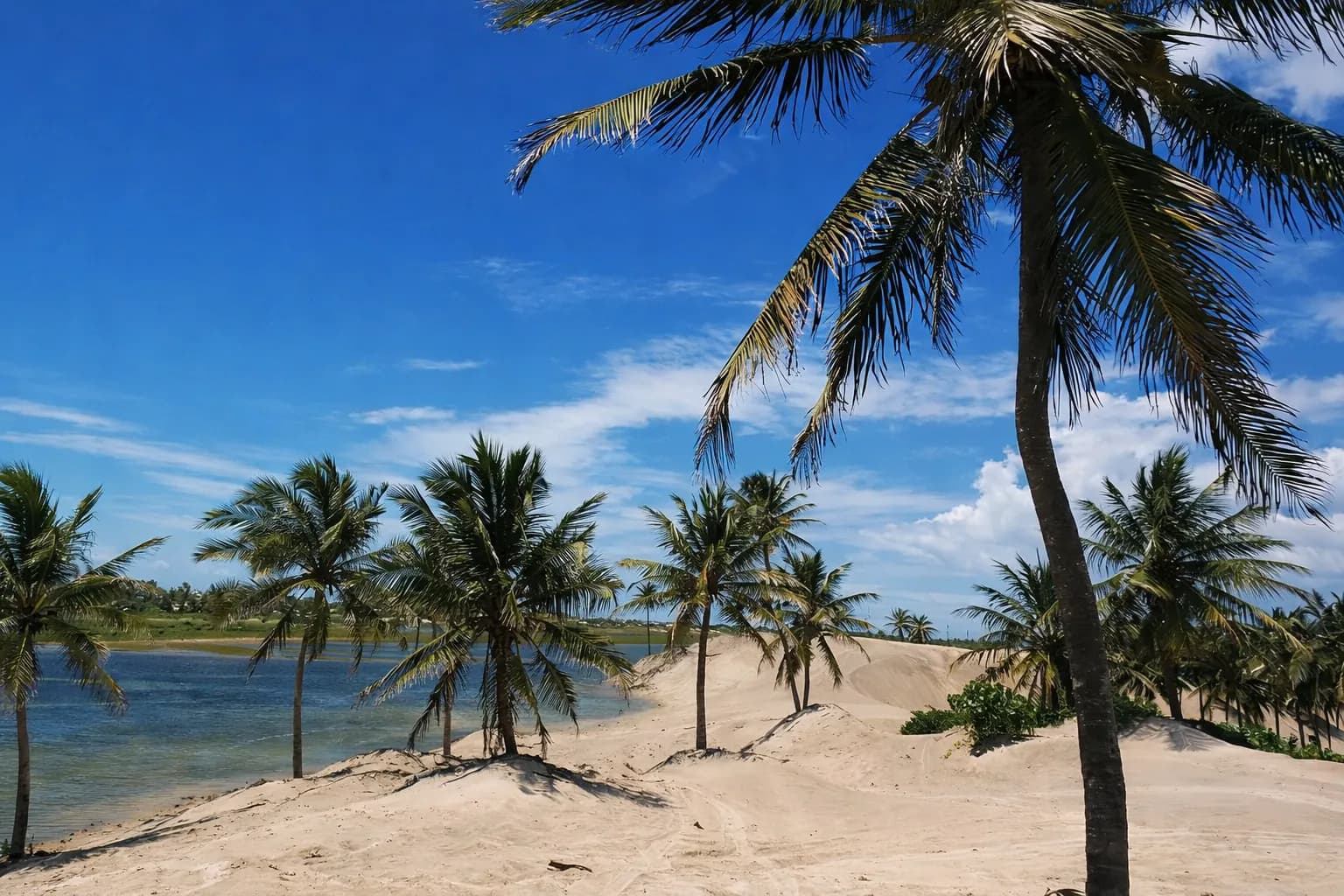
Barrinha de Baixo is the most remote point on Jericoacoara's East Side — a fishing village partially swallowed by dunes that advanced over the houses and now coexists with kite chalets facing the ocean. It sits 22–27 km east of Jeri, accessible only by buggy at low tide, and combines near-absolute silence with flat water and consistent wind from July to December.
Quick summary: Remote kite spot. Dunes over house ruins. No cell signal. Low tide access only.
What Is Barrinha
What you'll find:
- A fishing village of about 800 residents, within the municipality of Acaraú, Ceará
- Open beach with Atlantic waves on one side and shallow pools formed by the dunes on the other — an ideal setup for intermediate and advanced kitesurfing
- Dunes that advanced over former houses: ruins still visible under the sand mark the village's history
- Two or three beachfront restaurants serving lobster, octopus, and fresh fish straight from local fishermen
- A level of tranquility hard to find anywhere else on the northeast coast — no loud music, no large buggy groups
What you WON'T find:
- ATM — bring cash from Jeri or Acaraú
- Cell signal — most sources describe a complete absence; the occasional guesthouse with Starlink is the exception
- Pharmacy, market, or any urban services
- Paved access — the entire approach is along the sand strip, tide-dependent
When to Go
| Period | What to Expect |
|---|---|
| Jul–Dec | Consistent 20–25 knot winds — ideal kitesurfing season. Sand access is easier, dunes are dry, beaches are deserted |
| Jan–Mar | Intermittent rains inland; wind drops. Lush and green, minimal tourist presence — feels like you have the place to yourself |
| Apr–Jun | Transition: wind returns toward the end of this period. Lush post-rain vegetation, completely deserted beaches |
Access tip: Barrinha is reachable only at low tide. Local buggy drivers check the tide chart before departing — trips are cancelled or rescheduled based on tides. If going independently, plan at least 6 hours ahead.
How to Get There
Nearest airport: Jericoacoara (JJD) Distance: ~22–27 km east of Jeri along the sand strip, approximately 40–50 min by buggy Access type: Hard-packed sand at the waterline (low tide only)
The most common way to get there is by hiring a buggy tour from Jericoacoara. Barrinha is part of the so-called "Far East" — an add-on to the standard East Side tour (which ends at Buraco Azul and Lagoa do Paraíso). The surcharge is around R$150–200 per buggy, depending on the agency — an approximate figure, so confirm locally when you book. You must request it explicitly: Barrinha is not part of the standard East Side itinerary.
You can also get there by rented ATV, UTV, or jardineira from Jeri. The crossing requires sand-driving experience and tide knowledge — it's not recommended without a guide for first-timers on this stretch.
The distance from Preá is shorter: between 5 and 10 km, depending on the reference point. Kiteboarders from Preá often use Barrinha as a downwinder stop.
What to Do
1. Kitesurfing
Barrinha has established itself as a kite destination on its own merits. The wind blows from July to December with regularity and intensity comparable to the Jeri corridor spots — but with a fraction of the crowds. The open beach offers waves for wave riding; at high tide, shallow pools and channels between the dunes create flat water for freestyle and advanced beginners. There's a local kite school and at least one international school base with its own infrastructure for guests.
2. Beach, Dunes, and the Buried Village
Even non-kiters have reasons to come. Barrinha's beach is long, uncrowded, and framed by a field of shifting dunes stretching about 8 km along the coast. A walk through the dunes — especially in the late afternoon, when low light casts long shadows — is described as "the most beautiful sunset of all the Jericoacoara tours."
Barrinha's most surreal feature is the ruins of houses partially buried by sand. The former village was swallowed by the advance of shifting dunes (migrating dunes) — a documented geological phenomenon on the Ceará coastline, which has 295 km² of dunes in motion. Walls and structures are still visible under the sand, creating an almost post-apocalyptic look that no other village on this stretch has. The community reorganized closer to the beach and now lives alongside the dunes that once swallowed their homes.
For walkers: Wear comfortable footwear — the dune sand is soft and tiring on the climbs. Prefer early morning or late afternoon to avoid the midday sun. From Preá to Barrinha is 5 to 10 km along the sand strip, but most visitors arrive by buggy.
3. Fishing and Local Gastronomy
Barrinha is still a village of about 800 residents who live essentially from fishing. The municipality of Acaraú, to which Barrinha belongs, is Brazil's largest lobster producer — historically responsible for 31% of artisanal production, averaging 7,900 tons. Fishermen use traditional rafts (jangadas) and wooden traps (manzuás/covos) to catch lobster, octopus, shrimp, and various fish.
You can watch the boats come in early in the morning and buy fish, lobster, or octopus directly from the fishermen — much of what's served at the beach restaurants came from the sea hours earlier. Kitesurfing brought investment and infrastructure without displacing fishing: the two economies coexist, and tourism absorbs part of the catch that previously went to middlemen.
4. Silence and Disconnection
There's no public Wi-Fi, no cell signal in most of the area, and no organized nightlife. This is a feature, not a bug, for a certain type of traveler. At night, the sound is almost exclusively waves and wind. For those staying more than a day, Barrinha functions as a genuine retreat — rare on the northeast coast.
Where to Eat
Barrinha has between two and three beachfront restaurants — few, but they surprise with the quality of their fresh product. Don't expect extensive menus or sophisticated service: the logic here is fish and seafood of the day, served at simple tables overlooking the ocean.
What to eat
- Grilled lobster — served whole, at prices significantly below those in Jericoacoara. Found at at least two spots on the beach, with units costing around R$30–80 depending on size and establishment
- Octopus in olive oil — considered the standout dish of the local cuisine; olive oil, garlic, and a simple presentation that lets the ingredient quality speak
- Fish of the day — usually grilled or roasted; sharing portions for 3–4 people, between R$80–150
- Homemade desserts — artisanal cashew jam is produced by local families and appears as dessert at at least one of the establishments
The restaurants operate approximately from 10am–6pm (some close at 4pm). The prices above are ballpark figures. Confirm prices and availability with your buggy driver or directly on arrival — there's no guaranteed landline in every case.
Where to Stay
Accommodation in Barrinha is limited and books quickly in high season (July–December). Options range from simple fisherman's chalets to full-rental high-end houses.
| Profile | What to Expect | For Whom |
|---|---|---|
| Beachfront chalets | Simple setup with fan or AC, meals usually included | Kitesurfers, travelers seeking total immersion |
| Full-rental houses | 3–4 bedrooms, pool, AC, equipped kitchen — urban comfort in a remote location | Groups, couples escaping the city, high-end travelers |
| Smaller guesthouses | Individual rooms, family atmosphere, breakfast included | Organized backpackers, couples |
Accommodation (approximate figures): chalet nightly rates start from R$200–300/night in low season; full houses range from R$800–2,500/night depending on profile and period. Confirm directly with the guesthouse or owner before booking.
Book in advance for July–December. Barrinha's total capacity is estimated at fewer than 30 rooms/units — it sells out weeks ahead during peak months.
Plan your trip to Barrinha
Tides, routes, vendors — everything you need to plan.
3
places mapped
1
access route
Real-time tides
Insider tips
Know someone planning this trip? Send it their way.
Practicalities
- ATM: None in Barrinha. The nearest is in Acaraú or Jericoacoara — bring cash
- Cell signal: Virtually nonexistent. Carriers don't reliably cover the area. Some guesthouses with Starlink offer local Wi-Fi
- Wi-Fi: Only at some guesthouses; no public network
- Access: Sand strip at the waterline, exclusively at low tide — buggy, 4x4, ATV, or UTV
- Pharmacy: None. Bring basic medication, sunscreen, and insect repellent from Jeri
- Fuel: Not available. Buggy drivers and motorists fuel up before departing
- Best logistics base: Jericoacoara or Preá for a day trip; local accommodation for 2+ nights
FAQ
Is Barrinha accessible year-round?
Technically yes, but with important caveats. The beach is accessible only at low tide, regardless of the season. In the off-season (January–June), wind drops and tour demand falls — but access still depends on tides. Always check conditions before heading out.
How do I get to Barrinha without booking a tour?
You can go by rented ATV from Jeri, but it requires sand-driving experience and knowledge of the route. The route passes through stretches with no signage where the tide can cut off the path. For first-timers, going with a local guide or experienced buggy driver is the safest choice.
What's the best season for kitesurfing in Barrinha?
July to December. Wind is stronger and more consistent during this period, with regular 20–25 knot gusts. September and October tend to be the peak wind months. Outside this window, wind exists but is less predictable.
Is there an ATM in Barrinha?
No. There is no ATM, bank, or cash-withdrawal service in Barrinha. Bring enough cash for your entire stay — including meals, tips, and contingencies. The nearest ATM is in Jericoacoara or the town of Acaraú.
Is it worth spending more than one day in Barrinha?
It depends on your profile. For kitesurfers, two to four days is ideal — enough time to enjoy different tide and wind conditions. For those seeking genuine disconnection, the same logic applies. For day-trippers, one day is enough: arrive early, have lunch on the beach, explore the dunes, and head back before the tide rises.
Read Also
- Jericoacoara — Base and hub for the East Side
- Tatajuba — Maximum wind and river mouth, opposite direction
- Guriú — River mouth, ferry crossing, near Camocim
- Camocim — West Side base town, alternative airport
Last updated: August 2026