

Summary
| Item | Detail |
|---|---|
| What it is | Main town with full urban services on the Jeri–Barra Grande corridor |
| Best time | Jul–Feb (kite); Aug–Jan (peak) |
| How to get there | JJD ~96 km / ~1h15 by car via CE-085 (paved) |
| Highlight | Logistics hub + overland access to Tatajuba + flat water kite on the estuary |
| ATM | Yes (3 banks downtown) |
| Signal | Good downtown; weak at remote beaches |
| Hospital | Yes |
Ready to plan? Talk to us — we live here and help you build your itinerary.
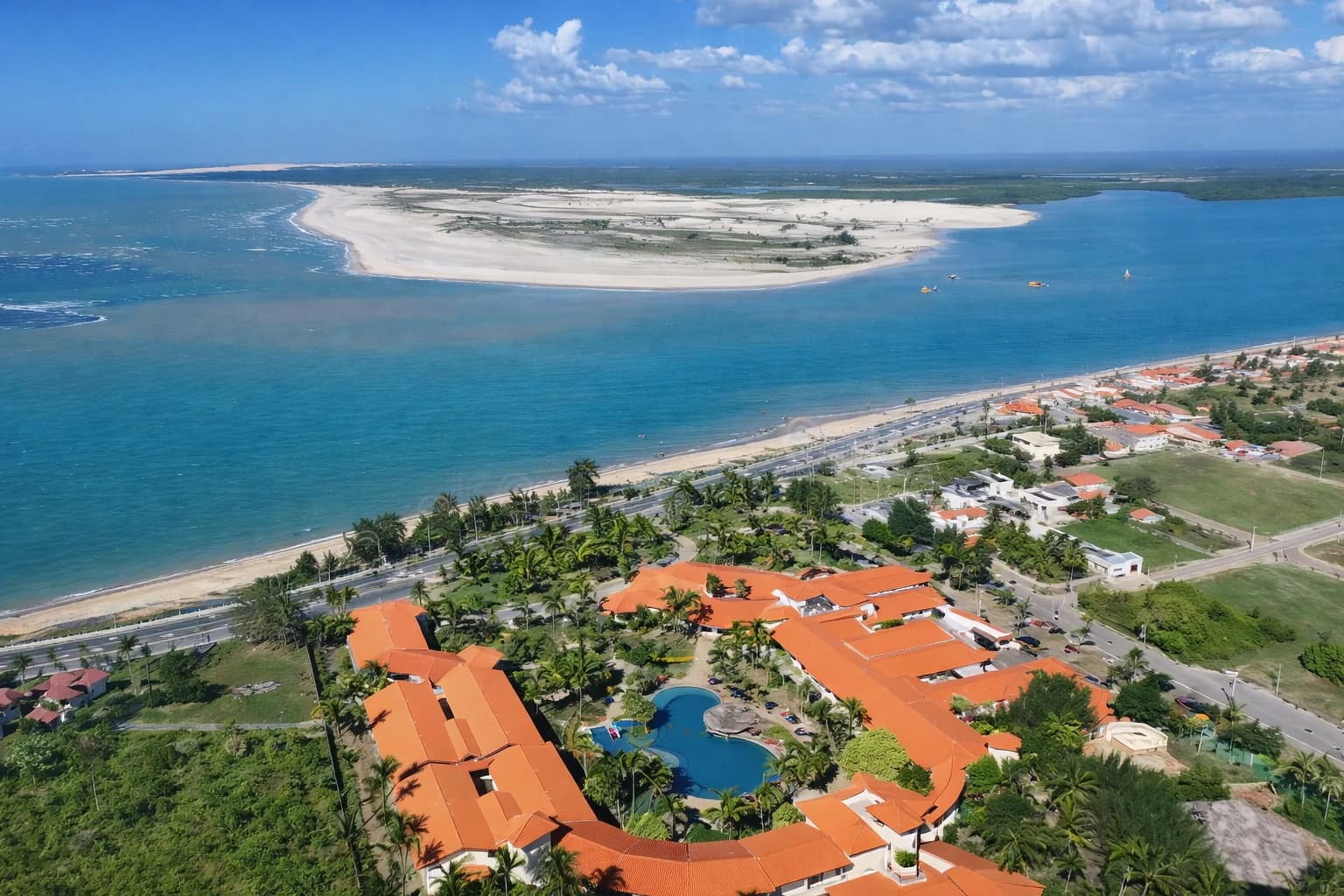
Camocim is the main town with full urban services — a bank, hospital, pharmacy, interstate buses — along the coastal corridor between Jericoacoara and Barra Grande. But don't be fooled into thinking this is just a supply stop: the Rio Coreaú delta delivers first-rate flat water kite, Praia do Maceió stretches 12 km of virtually empty sand, and Praia da Tatajuba — one of the most deserted and well-preserved beaches on the Ceará coast — is just 25 km of sand track from here.
Quick summary: Urban hub of the upper corridor. Ceará-Piauí gateway with full infrastructure, estuary flat water, and overland access to Tatajuba.
What Camocim Is
Camocim is a port city on the far northwest coast of Ceará, where the Rio Coreaú flows into the Atlantic, forming a wide, sheltered estuary. With around 65,000 inhabitants, it's the largest urban center on the route between Jeri and the Parnaíba Delta — which in practice means that when you need a bank, a hospital, an overnight pharmacy, or a bus to Fortaleza, Camocim is the place.
What you'll find:
- ATM-equipped banks (Banco do Brasil, Caixa Econômica, Bradesco — all downtown)
- Hospital and 24-hour urgent care (UPA)
- Pharmacies, supermarkets, and gas stations
- Interstate buses to Fortaleza, Parnaíba, and Teresina
- Flat water kite on the Rio Coreaú estuary
- Overland access to Tatajuba (25 km sand track, 4x4 or buggy)
- Urban beaches and fishing piers
What you WON'T find:
- Dense tourist infrastructure (most resorts are on the outskirts, not downtown)
- Top-tier swimming beaches in town — the best ones are 3–12 km from the center
- Significant nightlife outside peak season
When to Go
| Period | What to Expect |
|---|---|
| Jul–Feb | Best kite window: strong, consistent wind on the Rio Coreaú delta; downwinder Tatajuba to Camocim (~16 km, 1–3 m waves) |
| Aug–Jan | Absolute peak — strongest wind, most stable flat water, busiest kite school season |
| Mar–Jun | Interior rains, reduced wind; beaches still pleasant, fewer tourists, lower prices |
Insider tip: If you're combining Camocim with Tatajuba, plan to arrive from Jeri by downwinder between August and January. The overland return (4x4 or buggy along the beach) is the standard option for non-kiters — coordinate in advance because the sand track logistics can be affected by the tide.
How to Get There
Nearest airport: Jericoacoara (JJD) Distance: ~96 km — approximately 1h15 by car
The standard route from JJD to Camocim is via CE-085, a fully paved road. From the airport you pass through Jijoca de Jericoacoara and Cruz before entering the city — no 4x4 needed for this stretch. Camocim also has its own regional airfield (SNWC), with no scheduled commercial flights, but used for kite safari logistics and private charters.
From Fortaleza, you can take a bus (Expresso Guanabara, ~6h–7h via BR-222 and CE-085), or drive the same route (~350 km, ~5h). From Parnaíba (PI), access is via BR-402 to Chaval and then CE-085, about 2h by car.
For those on a kite safari from Jericoacoara, the classic sequence is a downwinder to Tatajuba or Guriú and from there to Camocim — combining kite and car/buggy logistics according to each rider's level and gear.
What to Do
1. Access Tatajuba by Land
Praia da Tatajuba — one of the most deserted and well-preserved beaches on the Ceará coast — is 25 km from Camocim via sand track (this is the overland distance; the downwinder over water is shorter, ~16 km). This is the overland access most travelers use to reach Tatajuba when they're not arriving by downwinder from Jeri. The track requires a 4x4 or buggy and timing depends on the tide: part of the route runs along the beach and is only passable at low tide. Leaving Camocim early in the morning, you can reach Tatajuba with time to fly kite, visit Lagoa Grande, and return before the tide closes the path.
2. Kite on the Rio Coreaú Delta
The Rio Coreaú estuary, near Praia do Maceió (12 km from downtown), is Camocim's main kite spot. Flat water at high tide, consistent side-onshore wind from July to February, and a reasonable kite school infrastructure on the beach. Several operators specializing in kite safaris use Camocim as a mandatory overnight stop on the Jeri–Parnaíba Delta route. For intermediate and advanced kitesurfers, the Tatajuba to Camocim downwinder (~16 km) is one of the most complete runs on the Ceará coast, with 1–3 m waves on the open section and flat water as you enter the estuary. Before heading out, check wind and tide in real time at rotainsider.com/condicoes.
3. Pedra do Frade and Praia das Barreiras
Three kilometers from downtown, Praia das Barreiras is where the Rio Coreaú meets the Atlantic. Low cliffs frame the sand strip, beach shacks serve fresh seafood, and the landscape changes dramatically depending on the tide. Pedra do Frade — an isolated rock formation in the sea — is the city's most iconic photo spot, especially at sunset when the light silhouettes the rock against the ocean.
4. Praia do Maceió
Twelve kilometers of fine sand with almost no development — just a few scattered beach shacks and the kite complex in the distance. Praia do Maceió doesn't have Jeri's infrastructure or Tatajuba's fame, but it has something neither of them does: space. For anyone who wants a quiet afternoon at the beach without packed shacks or buggies passing every minute, Maceió is the right choice. Cell signal is weak here — bring what you need.
5. Ilha do Amor
A small island facing Praia das Barreiras, accessible by public ferry from Avenida Beira Mar. The crossing takes less than ten minutes and costs a nominal fee — around R$5 per person. On the other side you'll find crystal-clear lagoons among the dunes, with virtually no infrastructure. Ideal for a half-day outing: bring water, sunscreen, and zero expectations of comfort.
6. Praia do Guriú
West of Camocim, Praia do Guriú is the departure point for boat tours to spot seahorses in the estuary and for the Guriú Mangrove Trail, a walk along boardwalks among the mangrove roots. Confirm operation and schedules locally — they depend on the tide and the season.
Where to Eat
Camocim has good variety for its size — from beachside seafood shacks to Italian cuisine in Maceió. Most of the better places are outside the center: either at Praia do Maceió (12 km) or Praia das Barreiras (3 km).
Downtown, the public market and popular restaurants around the main square serve hearty, affordable regional food — sun-dried beef with baião de dois (rice and beans), fried fish with pirão (fish broth thickened with manioc flour), and seafood stews. Prices between R$20–40 per person.
At Praia do Maceió, the level goes up: there's an established Italian restaurant on the waterfront, with reasonable pizza and pasta for interior Ceará, background music, and service from lunchtime (not just evenings, as sometimes rumored). Expect to pay R$40–70 per person. In the same area, a beachfront grill bistro serves grilled seafood at lunch and dinner, R$25–40 per person.
At Praia das Barreiras, local shacks serve the classic northeastern snack combo: butter shrimp, fish cooked on a tile, tapioca, and fruit juices. The sunset here is worth an extra beer.
For a different experience, the restaurant boat operating from Camocim's pier runs gastronomic cruises through the estuary with drinks, sushi, and appetizers — tours run around R$50–100 per person, drinks included.
Where to Stay
Camocim has options in two distinct profiles: practical downtown accommodation (for those passing through or wanting easy access to banks and transport) and beachfront guesthouses and resorts (for those here to kite or relax).
| Area | Vibe | Best For |
|---|---|---|
| Downtown | Practical, close to everything | Travelers in transit, those needing banks/hospital/buses |
| Praia do Maceió (12 km) | Kite-focused, international community | Kitesurfers, those looking for kite school infrastructure |
| Praia das Barreiras (3 km) | Quiet, estuary views | Couples, families, those wanting a beach without crowds |
| Rural outskirts | Glamping and bungalows in nature | Those seeking above-average comfort for the region |
At Praia do Maceió, an accommodation complex with a pool, sauna, and leisure area serves as a base for the region's international kite schools.
Prices vary by category and season. Low season (March–June) has significant discounts.
Plan your trip to Camocim
Tides, routes, vendors — everything you need to plan.
9
places mapped
4
access routes
Real-time tides
3
verified vendors
Know someone planning this trip? Send it their way.
Practicalities
- ATM: Yes — Banco do Brasil, Caixa Econômica Federal, and Bradesco downtown, all with ATMs. A machine may be out of service — carry cash as a backup
- Cell signal: Good downtown (all carriers); weak to nonexistent at Maceió and Barra dos Remédios
- Wi-Fi: Hotels and restaurants downtown; rare at the beaches outside the kite complex
- Access: Fully paved road (CE-085) — any car gets there without difficulty
- Hospital/Urgent care: Yes, downtown
- Pharmacies: Several downtown
- Gas: Stations at the city entrance and downtown
- Local airfield: SNWC (no commercial flights — charter and private hire)
Camocim is the standard overnight stop on kite safaris between Jeri and Barra Grande. For non-kiters who want to use the city as a base to visit Tatajuba, hire a transfer with a local 4x4 or buggy — the sand track requires a suitable vehicle and knowledge of the tide.
An important note about Ilha do Amor: the public ferry charges around R$4–5 per person — don't accept paying R$80–120 as some informal operators try to charge for a "private boat." The regular crossing is frequent, fast, and cheap.
About the Farol do Trapiá: the original lighthouse was demolished in January 2024 and replaced by a temporary structure. The lighthouse area is under Navy jurisdiction. The sunset from the nearby viewpoint is still beautiful, but don't go expecting the historic structure that appears in old photos.
Frequently Asked Questions
Is there an ATM in Camocim?
Yes — there are three bank branches downtown, all with ATMs: Banco do Brasil, Caixa Econômica Federal, and Bradesco. It's the main point on the corridor between Jeri and Barra Grande with this infrastructure. Even so, a machine may be out of service — carry cash as a backup.
How do I access Tatajuba from Camocim?
By land, it's 25 km of sand track requiring a 4x4 or buggy. Timing depends on the tide — part of the route runs along the beach and is only passable at low tide. Leaving early in the morning gives you time to go and return the same day.
Is Ilha do Amor in Camocim expensive to visit?
No. The public ferry from Avenida Beira Mar charges around R$4–5 per person, the crossing takes less than 10 minutes, and it runs on a regular schedule. Don't pay more than that — the crossing is a public service, not a private transfer.
What's the best time for kite in Camocim?
Wind blows for much of the year, but the ideal window is July to February, with peak from August to January. During this period the Rio Coreaú delta delivers consistent flat water and the Tatajuba to Camocim downwinder (~16 km) is in its best conditions.
Is Camocim worth visiting or is it just a transit stop?
It depends on what you're looking for. If your priority is beach and kite, Tatajuba and Jeri deliver more. But if you're on a multi-day itinerary along the corridor — or if you kite and want the classic downwinder — Camocim has the flat water estuary, Maceió, Barreiras, Ilha do Amor, and the hub logic: bank, hospital, buses, and access to Tatajuba. It's not a week-long destination, but it's not just a gas stop either.
Read Also
- Route of Emotions: the complete itinerary — the Jericoacoara–Parnaíba Delta–Lençóis corridor end to end, known in Portuguese as the Rota das Emoções
- Tatajuba — the kite spot with wind among the strongest and most consistent on the Ceará coast
- Guriú — mangrove, seahorses, and dunes west of Camocim
- Bitupitá — Ceará's last coastal frontier, where five rivers converge
- Jericoacoara — the most famous village on the corridor
- Barrinha — quiet village between Camocim and Bitupitá
Last updated: July 2026