

Summary
| Item | Detail |
|---|---|
| What it is | Second-largest island in the Parnaíba Delta. Best base for the Revoada dos Guarás and the igarapés. |
| When to go | Jul–Dec (peak). Guarás year-round. |
| How to get there | Parnaíba (PHB) → Porto dos Tatus (11–12 km) → Speedboat ~30 min |
| Highlight | Authentic community tourism in the heart of the only open-ocean delta in the Americas |
| ATM | No — bring cash |
| Signal | No signal — download offline maps before arriving |
| Wi-Fi | Only at guesthouses, limited |
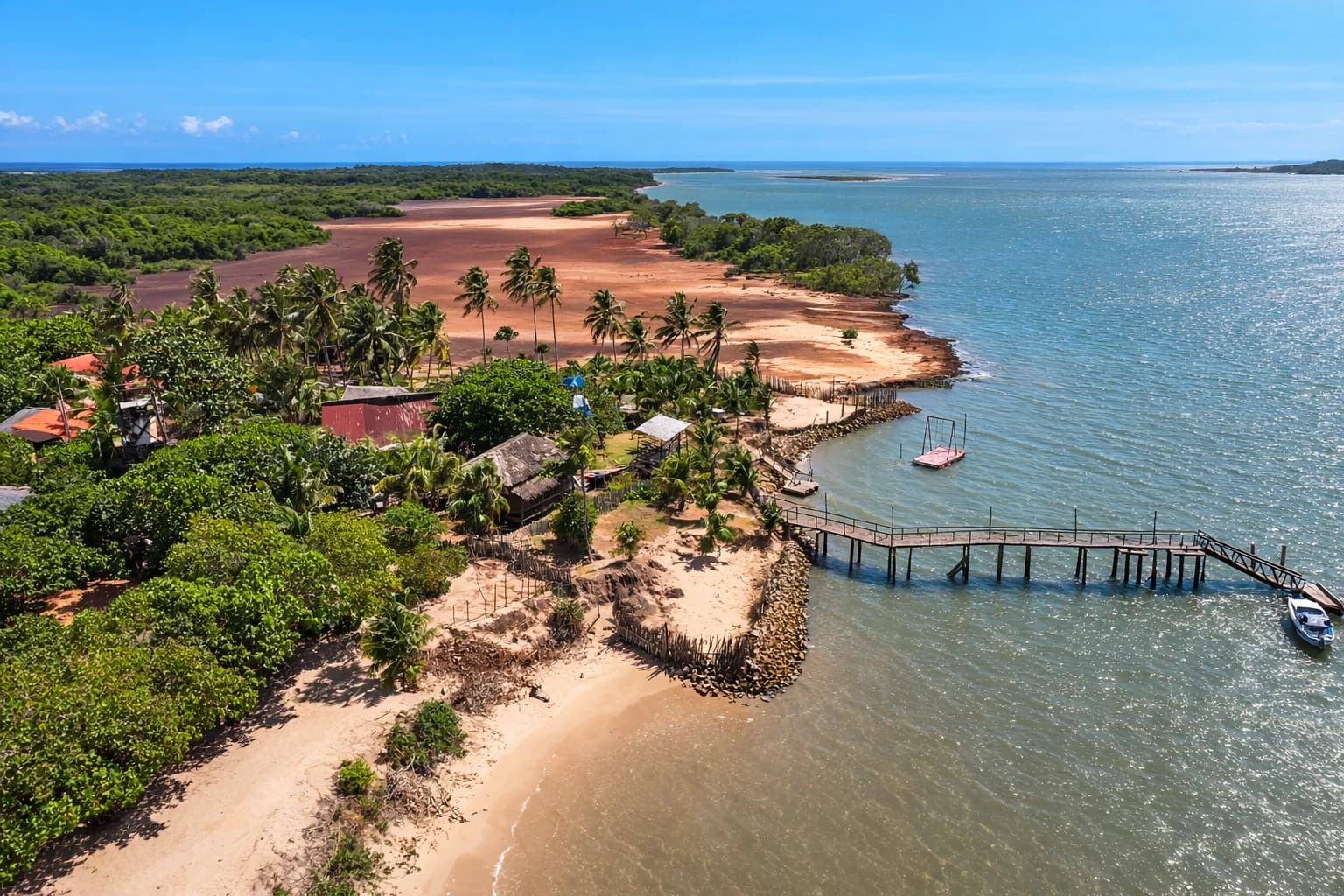
At dusk, hundreds of scarlet ibises arrive in crimson clouds to roost in the mangrove trees — an explosion of color that stops time. The Revoada dos Guarás is the most thrilling spectacle in the Parnaíba Delta, and Ilha das Canárias is the only place where you can experience it from the inside, spending the night on the island itself. The second-largest island in the Delta, with 17,000 hectares of untouched ecosystems and five fishing communities, Canárias is community tourism in its purest form — no resort, no facade.
Quick summary: Heart of the Delta. Best base for the Revoada dos Guarás and the deep igarapés.
What Ilha das Canárias Is
Ilha das Canárias sits in the Parnaíba Delta, the only open-ocean delta in the Americas, on the border between Piauí and Maranhão. With ~170 km² of area (including the mangroves), it is the Delta's second-largest island — the largest is Ilha Grande de Santa Isabel. The island is home to five communities: Caiçara, Canárias, Passarinho, Torto, and Morro do Meio, with about 2,500 residents who live from artisanal fishing and, increasingly, nature tourism.
What you'll find:
- Revoada dos Guarás at sunset — the most celebrated wildlife spectacle on the northeastern coast
- Narrow igarapés navigable by speedboat, with dense mangrove vegetation
- Night safari with caimans, iguanas, and owls in the Delta channels
- Boat trip to Ilha do Caju (private RPPN reserve, third-largest island in the Delta)
- Community-based tourism — meals at local guesthouses, direct contact with fishing families
- River beach on the channel banks, peaceful and crowd-free
What you WON'T find:
- ATM — bring cash
- Cell signal — the island has no towers; download offline maps before boarding
- Public Wi-Fi — some guesthouses offer limited satellite connection
- Pharmacy, market, or shop — bring everything you need
- Road transport — access is exclusively by boat
When to Go
| Period | What to Expect |
|---|---|
| Jul–Dec | Best window: Revoada dos Guarás at peak, dry season, regular wind, less rain |
| Jan | Still good for the Guarás; first rains beginning |
| Feb–Jun | Rainy season — Guarás present but in lower concentrations; igarapés fuller and more dramatic |
| Year-round | Night caiman safari operates every month |
Tip: The ideal window is July through December. If you want to build a festival into the trip, the Festival do Caranguejo (Crab Festival) runs in November, in the town of Ilha Grande (PI), with a canoe regatta at Porto dos Tatus. The exact weekend shifts each year — and a smaller Festival do Catador de Caranguejo runs a few days earlier. Confirm the year's dates before building logistics around it.
How to Get There
Nearest airport: Parnaíba (PHB) — a direct LATAM flight from Fortaleza (~1h), operating as of Aug 2026; confirm the schedule with the airline before locking in dates. By car, the drive from Fortaleza takes about 7h.
Departure point: Porto dos Tatus, ~11–12 km from central Parnaíba (~20–30 min by car, R$25–50 by transfer or Uber).
From Porto dos Tatus, access to the island is exclusively by water:
- Speedboat (voadeira): ~30 minutes to the island. The most common option for tourists. Prices vary widely — from R$10 on the regular ferry (slower, ~3h) up to R$2,520 for a private speedboat for larger groups.
- Shared launch: Intermediate time (~1h), more affordable than a private speedboat.
- Tutóia (MA): Alternative access from the Maranhão side — ~40–60 min by launch.
Most organized tours from Parnaíba already include round-trip transport. If going independently, arrange the return time with the boatman and confirm tide conditions before departing — navigation through the igarapés depends on water levels.
What to Do
1. Revoada dos Guarás
The most anticipated moment of any visit to the island. At dusk, flocks of scarlet ibises (Eudocimus ruber) arrive in crimson formations to roost in the mangroves — the contrast of scarlet plumage against the golden Delta sky is one of the most striking images in northeastern Brazil. The scene lasts 20 to 40 minutes and occurs with greatest intensity from July to January, though the ibises are present on the island year-round. The observation point is reached by boat, kept at a safe distance to avoid disturbing the birds.
2. Night Safari on the Igarapés
After sunset, local guides lead groups by speedboat through the dark Delta channels with flashlights. The goal is to spot yellow-bellied caimans in the water holes, iguanas sleeping on branches, and owls in the mangroves. The guides use ancestral techniques to detect animals by the reflection of their eyes. The tour runs year-round and is offered by operators based in Parnaíba, departing from Porto dos Tatus.
3. Navigating the Igarapés
The Delta's igarapés are narrow channels between walls of mangrove, where the boat brushes past the vegetation and the silence is broken only by the sound of water and birds. Larger launches (up to 14 passengers) cover the main channels; for the tighter igarapés, smaller speedboats are essential. The tour lasts 2 to 4 hours depending on the route and is the best way to understand the Delta's ecological complexity.
4. Visiting the Communities
Canárias, Caiçara, and Passarinho are the most visited communities. Community-based tourism here is genuine: residents offer home-cooked meals, local crafts, and stories about life in the Delta. There is no museum or formal visitor center — contact happens directly, in homes and at the docks. Spending the night on the island, rather than doing a day trip from Parnaíba, is what makes this experience possible.
5. Trip to Ilha do Caju
Ilha do Caju is the Delta's third-largest island and is home to an RPPN (Private Natural Heritage Reserve) with dunes, river beaches, native cashew trees, and abundant wildlife. From Ilha das Canárias the access is short; from Porto dos Tatus the tour costs about R$175/person on a shared boat (~1h30 by launch). It's a classic Delta itinerary that pairs well with the Revoada dos Guarás on the same day or the following day.
Where to Eat
The dining scene on the island is limited and directly tied to the guesthouses and local families — there are no independent restaurants in the conventional sense. That's part of the charm: you eat what the fishermen eat.
What to expect:
- Moqueca de frutos do mangue — the island's signature dish, made with crab, blue crab, and fresh shrimp from the mangrove. The most celebrated version is served at a reference guesthouse-restaurant in the main community.
- Moqueca de peixe — Delta fish (filhote, mullet, catfish) in a stew with coconut milk and dendê oil.
- Pirão de peixe — an essential side dish.
- Caranguejo no vapor — served whole, eaten with your hands.
Prices are modest and portions generous. Meals are usually served at the guesthouse where you're staying — confirm in advance if you need lunch or dinner, as provisioning logistics on the island require planning.
Where to Stay
Accommodation on the island is simple and community-run — far from a resort standard, close to the real Delta experience. There are at least four confirmed options:
| Type | Price Range | Profile |
|---|---|---|
| Reference guesthouse-restaurant (main community) | R$350–600/night | Suites with air conditioning, minibar, limited Wi-Fi, pool. The most established option on the island. Book well in advance — it sells out. |
| Beachfront guesthouse (Delta view) | ~R$299/night (triple room) | Guesthouse with own restaurant and pool. Known for fresh fish. |
| Riverside guesthouse | R$200–390/night | Wi-Fi, bar, library. Located on a channel bank. Some rooms accept pets. |
| Nature guesthouse (for groups) | ~R$280/night (quad room) | Most affordable option, vegetarian breakfast, tranquil setting. |
Camping: Possible in areas near some guesthouses and at spots on the channel banks. There is no official campground — arrange directly with local residents.
Note: We don't list accommodation names with direct contact on this page — we pass on verified contacts and updated availability over WhatsApp.
Plan your trip to Ilha das Canárias
Tides, routes, vendors — everything you need to plan.
7
places mapped
1
access route
Real-time tides
Insider tips
Know someone planning this trip? Send it their way.
Practicalities
- ATM: None on the island. The nearest is in Parnaíba. Bring enough cash for your entire stay.
- Cell signal: Nonexistent. The island has no cell towers. Download offline maps, save necessary contacts on your phone, and let family know before you leave.
- Wi-Fi: Some guesthouses offer satellite connection, limited and intermittent. Don't count on stable access.
- Pharmacy / shop: None. Bring insect repellent (essential — mosquitoes at dusk), sunscreen, ongoing medications, and anything else you'll need.
- Electricity: Available at guesthouses via generator or grid — confirm operating hours.
- Access: Exclusively by boat. Confirm tide times with the boatman before boarding — the igarapés depend on water levels.
- Cash: All transactions on the island are in cash. Bring more than you think you'll need.
- Language: Portuguese — no tourist infrastructure in English on the island.
The boat from Porto dos Tatus (~11 km from Parnaíba) takes ~30 minutes by speedboat. Arrange the return in advance — there is no regular service with fixed schedules for tourists.
Frequently Asked Questions
Is there an ATM on Ilha das Canárias?
No. The island has no ATM or bank branch. The nearest is in Parnaíba, ~30 minutes by boat plus ~20 minutes by car from Porto dos Tatus. Bring all your cash before boarding — guesthouses and tours on the island are paid exclusively in cash.
What's the cell signal like on Ilha das Canárias?
Nonexistent. The island has no cell towers. Download offline maps, save boatman and guesthouse contacts on your phone, and let family know before you leave. Some guesthouses offer satellite Wi-Fi, but the connection is intermittent.
What's the best time to visit Ilha das Canárias?
The ideal window is July through December. During this period the Revoada dos Guarás is at its peak — larger flocks, better light at sunset, and dry season with less rain. The night caiman safari runs year-round. February through June is the rainy season and the ibises appear in lower concentrations, but the igarapés are fuller and the vegetation more lush.
Is it possible to do a day trip from Parnaíba or is it better to stay overnight?
Both are possible, but staying overnight completely transforms the experience. A day trip lets you see the Revoada and the igarapés, but you miss the night safari, breakfast on the island, the silence of the Delta at dawn, and real contact with the communities. If time allows, stay at least one night.
Is Ilha das Canárias worth it?
For those seeking raw nature and authentic community experiences, absolutely — by a wide margin. The Revoada dos Guarás is one of the most powerful natural spectacles in Brazil. The island has no resort infrastructure and requires planning (cash, offline, boat logistics), but those who make peace with the simplicity leave transformed. It's not a destination for those who need comfort or connectivity.
Read Also
- Parnaíba — Delta logistics hub, starting point for all tours
- Barra Grande PI — Beach village on the Piauí coast, ~70 km from Parnaíba
- Cajueiro da Praia — Peaceful village with lagoons and white-sand beach
- Tutóia — Gateway to the Delta from the Maranhão side
Last updated: August 2026