

Quick Summary
| Item | Detail |
|---|---|
| What it is | Kite village with one of the largest flat water lagoons in the Northeast |
| Standout | Bed-to-board model, 4+ km lagoon with no waves, submerged sandbars |
| Best time | July to January (18–28 knot wind, flat water) |
| How to get there | Nearest airport: Jericoacoara (JJD), ~61 km; main gateway: Fortaleza (FOR), ~220 km via CE-085 |
| ATM | None — bring cash (withdraw in Itarema) |
| Signal | Limited (Vivo, can drop out) — Wi-Fi/Starlink at guesthouses |
| Wi-Fi | At guesthouses |
| Access | Paved road + final stretch of sand/dirt |
Ready to plan? Talk to us — we live here and help you build your itinerary.
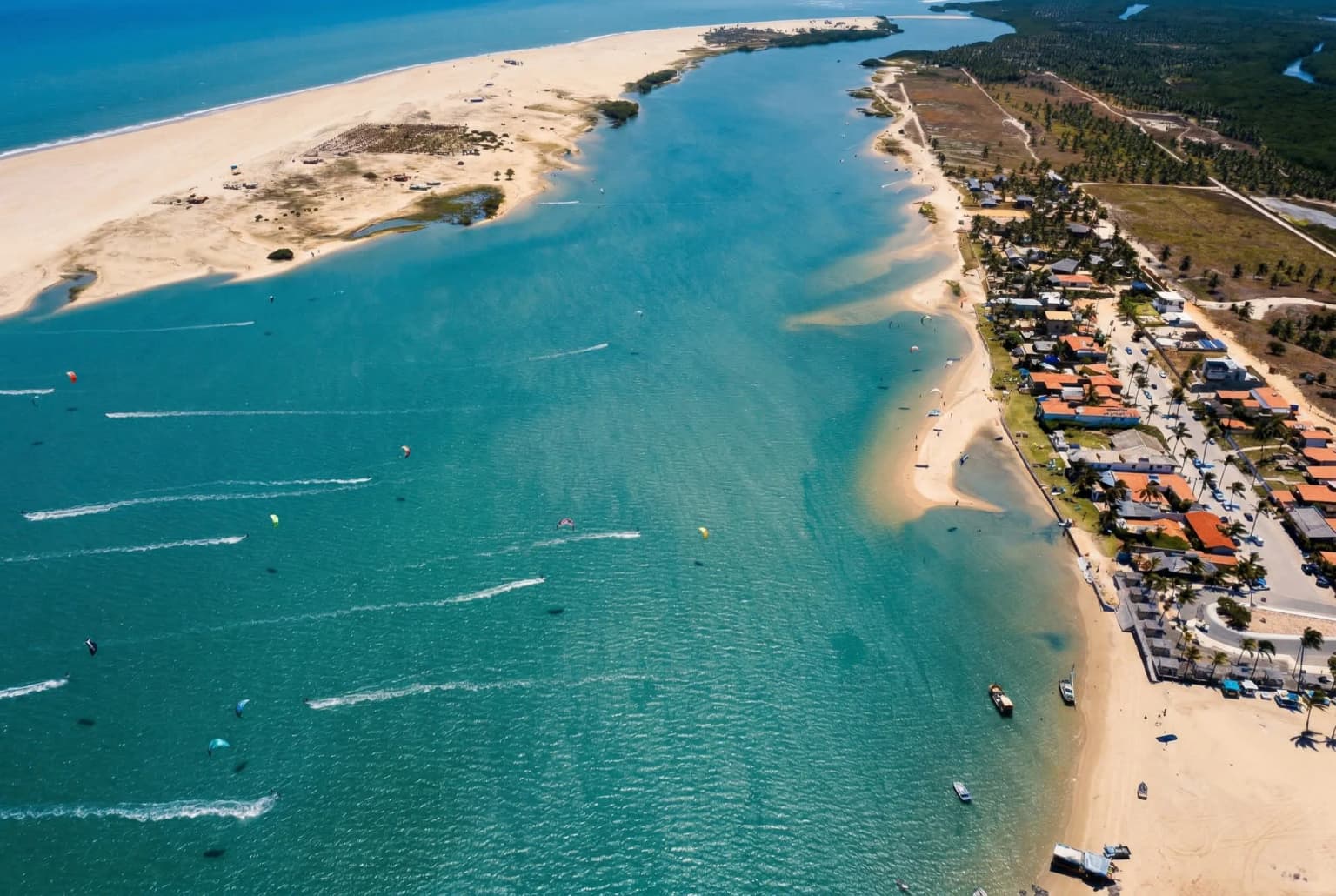
Ilha do Guajiru in Itarema (CE) — Ceará's west coast, ~220 km from Fortaleza.
-2.885, -39.899 · OpenStreetMapIlha do Guajiru is one of the most complete flat water kite spots on the Ceará corridor. The lagoon — over 4 km long, 400 m wide, average depth of 1 meter — creates a turquoise mirror where beginners learn without the fear of waves and freestylers execute tricks over submerged sandbars. Hundreds of meters of knee-deep water in every direction: it's what the international crowd calls "The Flatwatersea." All of this 220 km from Fortaleza, within the municipality of Itarema. Don't confuse it with Guajiru, in Trairi (~100 km to the southeast): they are completely different destinations.
Quick summary: Flat water with 18–28 knot wind from July to January. Guesthouses on the lagoon's edge with direct kite access. Starting point for downwinds to Jericoacoara (~65 km via Preá).
What Is Ilha do Guajiru
Ilha do Guajiru is a kite tourism village situated on a strip of land between the Atlantic Ocean and the lagoon of the same name, in the municipality of Itarema (CE). The feature that sets it apart from the rest of the Northeastern corridor is the bed-to-board model: most guesthouses sit on a narrow strip adjacent to the kite area, eliminating the commute between accommodation and water. You wake up, grab your gear, and you're at the lagoon in minutes.
What you'll find:
- Flat water lagoon over 4 km long and 400 m wide — one of the largest flat water kite areas in the Northeast
- Average depth of 1 meter, with submerged sandbars where you can walk hundreds of meters in knee-deep water
- Dozens of guesthouses with direct lagoon access, bed-to-board model
- ABK-accredited kite schools operating at the water's edge
- Starting point for epic downwinds to Jericoacoara (~65 km via Preá)
- Authentic fishing village with simple food and affordable prices
What you WON'T find:
- ATM in the village — bring cash withdrawn in Itarema before arriving
- Strong, constant cell signal — Vivo is the most reliable, but it can drop out
- Public Wi-Fi outside the guesthouses — but several guesthouses have Wi-Fi/Starlink
- Nightlife or attractions beyond kite and nature
Note: Don't confuse this with Guajiru in Trairi — a different municipality, located about 100 km to the southeast. This guide is about Ilha do Guajiru, in Itarema.
When to Go
| Period | Conditions | Best For |
|---|---|---|
| Jul–Jan | 18–28 knot wind, flat water, water temperature 27–30 °C | Kite (ideal — best window of the year) |
| Jul–Dec | Peak season: most consistent wind, lowest chance of calm days | Advanced kite and downwinds |
| Oct–Dec | Seasonal international schools reinforce the village's setup | Intermediate and advanced riders with coaching |
| Feb–Jun | Rain, weaker and irregular winds | Avoid for kite; accommodation prices drop |
Timing tip: Arrive before noon. The wind in Itarema is more consistent and smoother in the morning — afternoons can get gusty with irregular gusts. For the lagoon, mid or high tide is ideal: at low tide, the water surface shrinks significantly. Track wind and tide in real time at rotainsider.com/condicoes.
The main window runs from July to January — 18–28 knot wind, air temperature of 32–33 °C, water temperature of 27–30 °C. The wind is stronger and steadier in high season (~Aug–Dec, ~20–30 knots); within the window, July to December is the safest period for those who depend on consistency.
How to Get There
Nearest airport: Jericoacoara (JJD) — Comandante Ariston Pessoa Regional Airport, in Cruz, ~61 km away (~1h–1h30) Main gateway: Fortaleza (FOR) — Pinto Martins International Airport, ~220 km away (~2h30 by car), with far more domestic and international flights Access type: Mixed — paved road to near the village, with a final stretch of packed sand/dirt
By Car (recommended route)
The most direct route leaves Fortaleza via the CE-085 (western coast) toward Itarema. The road is paved for almost the entire route — recent improvements were made thanks to the installation of wind farms in the region. After Itarema, follow signs for Ilha do Guajiru. The last few kilometers are on packed sand; a regular car gets through fine in the dry season, but a higher-clearance vehicle is preferable during rainy periods. Anyone flying into Jericoacoara airport (JJD) has a much shorter transfer — about 61 km to the village.
Important tip: there's no ATM in the village — bring cash. Withdraw in Itarema before entering: the ATMs are in the town center, at the Banco do Brasil branch and the Bradesco kiosk.
By Bus
There are daily bus services from Fortaleza to Itarema — Expresso Guanabara runs the stretch for ~R$60, in about 4h. From Itarema, local taxis and mototaxis complete the trip to the lagoon. The combination is slower (3h30–4h) but economical for those traveling without gear.
Private Transfer
Transfers from Fortaleza direct to Ilha do Guajiru are offered by agencies and independent drivers. Estimated average price: R$200–350 per vehicle (4 people) — confirm the fare when booking, as it varies by season and departure point.
What to Do
1. Kite on the Lagoon (The Main Spot)
Lagoa do Guajiru is the reason people come from all over Brazil and Europe to Itarema. Over 4 km long, 400 m wide, average depth of 1 meter — turquoise water with no waves, no significant current, and consistent wind entering through the lagoon opening. Freestylers call it "The Flatwatersea."
What makes the spot unique is the underwater topography: submerged sandbars allow you to walk hundreds of meters in knee-deep water. If you take a fall, you'll probably land on your feet. For beginners, it's the safest environment on the corridor — ABK schools with full infrastructure operate at the water's edge. For freestylers, it's a playground: everything flat, 18 to 28 knot winds, no obstacles.
The lagoon is subject to tidal variation. At mid or high tide, the water surface is larger and more rideable. Arrive before noon for the most stable wind.
2. Downwind to Jericoacoara (Via Preá)
Ilha do Guajiru is one of the classic launch points for downwinds on the Northeastern corridor. The route goes from Guajiru to Jericoacoara covering ~65 km of coastline (distance varies depending on the path taken). Along the way, it passes through Preá — a natural stop for water and a snack.
For those who prefer a shorter downwind, the Almofala → Guajiru route (~40 km) is a popular and equally beautiful option, with segments of deserted coast and beaches with no infrastructure.
Downwinds require experience and logistical support (someone to pick up the gear at the destination). Talk to local schools before heading out solo.
3. Lagoon and Sandbanks on Foot
Even non-kiters enjoy the lagoon. At mid tide, you can walk hundreds of meters into the water over the sandbars, with water reaching waist level at most. The clarity is exceptional — you can see the bottom at any point. Sunset on the lagoon, with the orange sky reflected on the flat surface, is one of the most photogenic spectacles on the Ceará coast.
Kayaking and stand-up paddle are common morning activities, before the wind picks up.
4. Mangroves and Estuary
Around Ilha do Guajiru there are mangrove formations that can be explored by kayak or on foot at low tide. The ecosystem is a habitat for guará (scarlet ibis) and other coastal birds. It's a peaceful break in the middle of an intense kite itinerary — ask at your guesthouse about the safest access.
5. Fishing Village and Simple Life
The "island" part of Ilha do Guajiru — the local fishing community — contrasts with the tourist infrastructure around the lagoon. Walks along the Atlantic coast reveal anchored jangadas (traditional rafts), nets spread out in the sun, and a pace of life completely disconnected from kite tourism. This duality is part of the village's charm.
Where to Eat
Ilha do Guajiru's food scene is small but surprisingly good for a village this size. Most restaurants serve fresh seafood from the Atlantic and the lagoon. Prices are affordable — expect to pay R$40–80 per person for a full dinner with drinks.
Seafood (Must-Try)
The culinary highlight of the village is fresh fish in sauce and octopus moqueca — dishes that appear on practically every menu at the lagoon-side restaurants. Sesame-crusted tuna is another acclaimed specialty, influenced by the European kite tourists who settled in the region. Seek out restaurants with a direct view of the lagoon — the setting adds as much as the food.
There's also a bistro specializing in paella with Spanish bomba rice and artisan pasta, open to guests and non-guests. It operates for dinner, with a more intimate atmosphere and a smaller menu.
Simple Meals and Daily Options
For quick lunches between kite sessions, the shacks by the lagoon serve daily plates (rice, beans, fried fish, salad) for R$20–35. They're informal, fast, and filling. Some guesthouses offer breakfast included — check when booking.
Practical tip: There's no well-stocked supermarket in the village. If you have specific dietary needs (strict vegetarian, celiac), bring what you need from Itarema or Fortaleza.
Where to Stay
Ilha do Guajiru has one of the most developed bed-to-board models on the Northeastern corridor: most guesthouses sit on a narrow strip between the lagoon and the ocean beach, with direct kite access. The zones below reflect relative position in the village — not establishment names.
| Zone | Vibe | Best For | Estimated Price Range |
|---|---|---|---|
| Lagoon-side | Direct kite access, no commute. Guesthouses with gear storage. | Kitesurfers (any level) | R$150–400/night |
| Ocean-facing | More ventilated, Atlantic views. Slightly farther from the lagoon. | Couples, non-kite travelers | R$120–300/night |
| Village interior | Cheaper, simpler, living alongside the local community. | Backpackers, long stays | R$80–150/night |
High season: July to January, when the wind is consistent. During this period, book at least 2–3 weeks in advance — lagoon-side guesthouses fill up fast.
Note: Some lagoon-side guesthouses also have a kite school and rental gear on-site. If you want to minimize logistics, ask when booking whether the guesthouse has this integrated setup.
Prices are estimates and vary by category, season, and availability.
Plan your trip to Ilha do Guajiru
Tides, routes, vendors — everything you need to plan.
4
places mapped
6
access routes
Real-time tides
2
verified vendors
Know someone planning this trip? Send it their way.
Practicalities
| Item | Detail |
|---|---|
| ATM | None in the village — bring cash withdrawn in Itarema (Banco do Brasil / Bradesco in the center) before arriving. |
| Cell signal | Limited — Vivo is the most reliable, but it can drop out. Download offline maps as a precaution. |
| Wi-Fi | At guesthouses (many with Starlink; variable quality). Outside them, don't count on stable internet. |
| Road access | Paved road to near the village + final stretch of packed sand/dirt. Regular car gets through in the dry season. |
| Wind | More stable before noon. Afternoons can get gusty. Best window: Jul–Jan. |
| Tide | The lagoon varies with the tide. Mid or high tide = larger water surface. Low tide = reduced lagoon. |
| Fuel | Fill up in Itarema. There's no gas station in the village. |
| Health | No health post in the village. Emergencies: Itarema (~15 km). |
| Municipality | Itarema (CE) — don't confuse with Guajiru in Trairi (~100 km southeast, different municipality). |
Frequently Asked Questions
Is Ilha do Guajiru good for learning to kitesurf?
Yes — it's one of the best environments for beginners in all of Brazil. The lagoon has no waves, the depth is about 1 meter across most of the area, and the submerged sandbars allow breaks and walking outside of the kite. Multiple ABK-accredited schools operate directly on the lagoon with experienced instructors. The only caveat is to arrive early (before noon) for the most stable wind.
Is there an ATM in Ilha do Guajiru?
There's no ATM in the village — bring cash. Withdraw what you need in Itarema (the municipal seat, ~15 km away) before entering the village: there are Banco do Brasil and Bradesco branches in the center. Some guesthouses and restaurants accept cards, but it's not guaranteed at every establishment.
When is the best time to visit Ilha do Guajiru?
The main kite window is July to January, with 18 to 28 knot winds and flat water. Within that period, July to December offers the greatest consistency, with the strongest wind in high season (~Aug–Dec). The wind can start as early as mid-June and extend into February in good years. Avoid March to May (rain, irregular winds).
How do I get to Ilha do Guajiru from Fortaleza?
From Fortaleza, the most direct route is via the CE-085 (western coast), ~220 km, averaging 2h30 by car, with a final stretch of packed sand/dirt. Anyone flying into Jericoacoara airport (JJD) is much closer — ~61 km. There are also buses from Fortaleza to Itarema (Expresso Guanabara, ~R$60/~4h), from where local taxis complete the trip. Fill up and bring cash before leaving Itarema.
Ilha do Guajiru or Preá — which one to choose?
It depends on your profile. Guajiru is better for freestyle and progression — flat lagoon, bed-to-board, a more kite-focused setup. Preá is better for those who want waves and the energy of Jericoacoara for less money, with walking access to Jeri. If you want to learn or practice flat water, go to Guajiru. If you want to mix kite with the Jeri lifestyle, Preá is more strategic.
Read Also
- Route of Emotions (Rota das Emoções) — The corridor's flagship route: Jericoacoara → Parnaíba Delta → Lençóis Maranhenses
- Icaraí de Amontada — 9 months of wind, the longest window on the corridor
- Preá — Waves and flat water at the doorstep of Jericoacoara
- Jericoacoara — The corridor's epicenter, dunes and sunset on the rock
- Camocim — Delta do Coreaú, the only town with urban services on the upper corridor
- Wind and tide conditions — Forecast to plan your kite sessions