

Summary
| Item | Detail |
|---|---|
| What it is | Fishing village of ~2,000 people with an internationally recognized flat water kite spot |
| When to go | Jul–Jan (kite); Sep–Dec is the peak |
| How to get there | Parnaíba (PHB) ~40 km (~1h); high-clearance vehicle recommended |
| What sets it apart | Camurupim River lagoon — unique flat water, 2.4 m tidal range, IKO and VDWS schools |
| ATM | No — bring cash from Luís Correia or Parnaíba |
| Signal | Weak (Vivo only, inconsistent) |
| Road | Sand — 4x4 recommended for the final stretch |
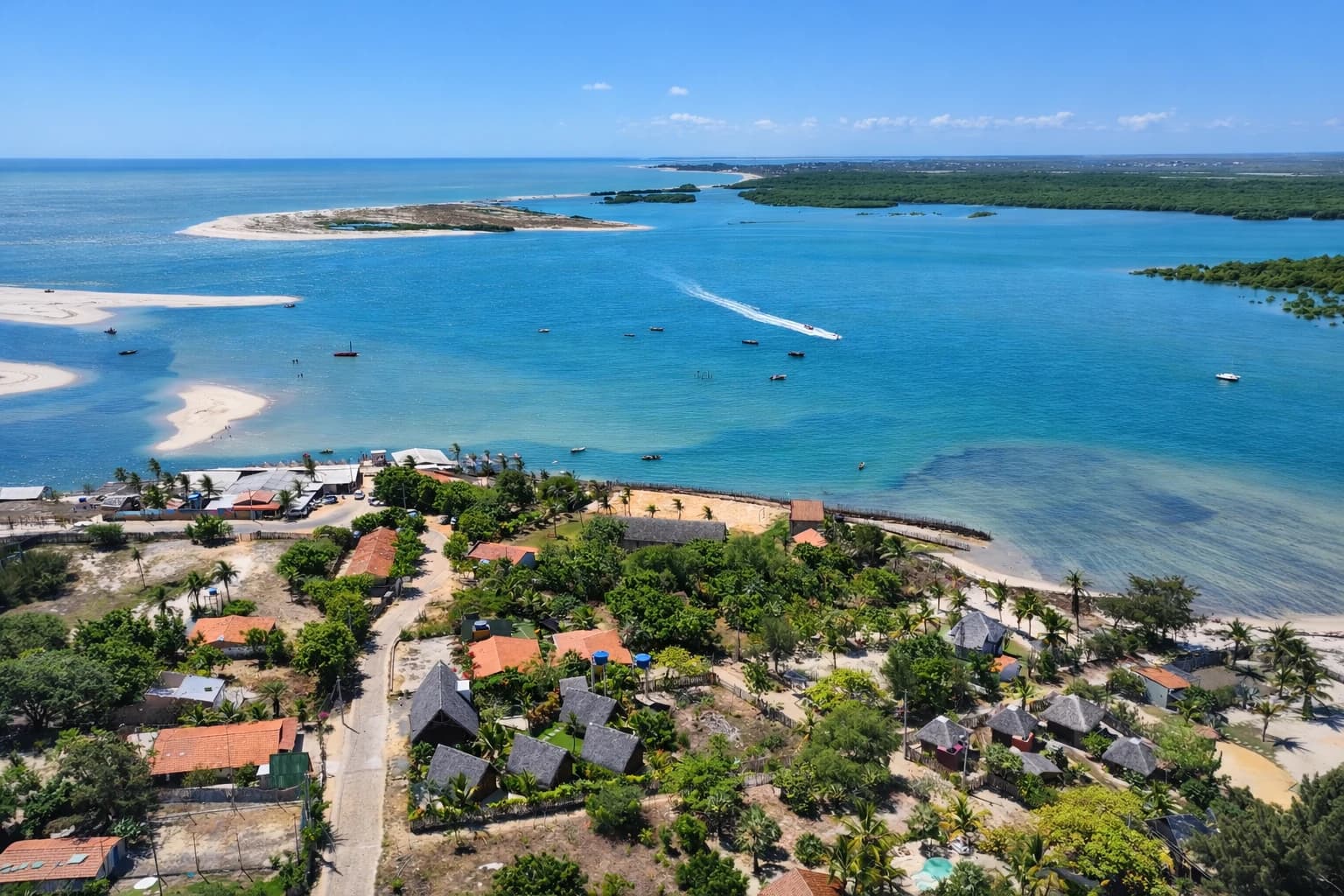
Macapá is a fishing village of about 2,000 residents at the mouth of the Camurupim River — the last beach in the municipality of Luís Correia before the border with Cajueiro da Praia. Geographically unassuming, it harbors the purest flat water kite spot on the entire Piauí coastline: the estuary lagoon creates ultra-shallow water mirrors where the 2.4-meter tide sculpts unique conditions with every cycle. In recent years, European-origin kite schools have set up full infrastructure here, transforming the village into an international reference for freestyle and advanced courses — without losing its remote village soul.
Quick summary: World-class flat water kite. Infrastructure present, vibe still small.
What Is Macapá
Macapá sits at the far north of the Luís Correia shoreline, separated from Barra Grande only by the Camurupim River. The north-facing beach catches the trade winds at full force between July and January, and the combination of consistent wind with a shallow, flat bottom creates conditions that attract kitesurfers from around the world.
Despite the well-developed kite infrastructure, the rest of the village remains genuinely simple: sand streets, fishermen's houses, no ATM, no pharmacy. Those arriving expecting a beach resort will be surprised — for better or worse.
What you'll find:
- Internationally recognized flat water kite spot
- Kite schools with IKO and VDWS certifications, top-end gear
- Beach shacks with fresh seafood
- A few simple guesthouses, focused on the kite crowd
- Silence, sand, and sunsets without crowds
What you WON'T find:
- ATM — bring cash from Luís Correia or Parnaíba
- Pharmacy or health clinic
- Reliable cell signal (only Vivo works in some spots)
- Wi-Fi outside guesthouses and kite schools
- Nightlife or varied shopping
When to Go
| Period | Conditions | For Whom |
|---|---|---|
| Jul–Jan | Kite season. Consistent SE/E wind, averaging 22–24 knots, with peaks of 35 knots. Spot active virtually every day. | Kitesurfers of all levels |
| Sep–Dec | Peak season. Slightly windier than Barra Grande. Ideal for advanced freestyle and technical progression. | Experienced kitesurfers |
| Feb–Jun | Kite off-season. Irregular wind. Quiet beach, good for those seeking peace with no sports agenda. | Travelers wanting total escape |
Tide tip: The best kite session happens at low tide, when sandbars form mirror-like pools 30–80 cm deep. Spring tides (full/new moon) amplify this effect.
How to Get There
Nearest airport: Parnaíba (PHB) — ~40 km, approximately 1 hour of travel.
From Parnaíba: Take the BR-402 toward Luís Correia. After the town of Luís Correia (~27 km from Parnaíba), continue along the shore to Praia de Macapá. The final stretch from Luís Correia to Macapá is on sand — a high-clearance vehicle or 4x4 is recommended, especially on rainy days or when the tide is coming in.
From Luís Correia: Just ~13 km along the northern shore, a sand track that takes 20–30 minutes depending on conditions.
From Barra Grande: The drive is 40–60 minutes, since the route has to loop around the Camurupim River via Luís Correia. By kite, the trip takes ~10 minutes — Macapá is a 2–4 km downwinder from the Barra Grande shoreline.
From Parnaíba by bus: There are regular bus lines between Parnaíba and Luís Correia. From Luís Correia to Macapá, access is usually by mototáxi or local ride-hailing app.
What to Do
1. Kitesurfing at the Camurupim River Lagoon
This is the main reason most people come to Macapá. The Camurupim River estuary forms a ~3 km² basin of flat, shallow, sheltered water — the ideal environment for learning kite or progressing freestyle techniques. At low tide, sandbars create mirror-like pools where the water barely reaches your knees, making falls painless and first flights safe.
The season runs from July to January, peaking between September and December. The wind here tends to be slightly stronger and more consistent than in Barra Grande, which explains the concentration of certified schools — it's a spot that "forgives" beginners and challenges intermediates at the same time.
2. Beach Life and Fishing Culture
Outside the kite window, Macapá has the soul of a northeast coast fishing village. In the early morning, colorful wooden boats return with the night's catch — traditional rafts (jangadas) and artisanal canoes that catch robalo (snook), camurupim (tarpon), and shrimp using line, hook, and traditional nets. At the beach shacks, lunch is prepared from what came out of the sea hours earlier.
The camurupim (tarpon, Megalops atlanticus) holds deep cultural significance here: it can exceed 2 meters and 150 kg, and the tradition of catching it passes from generation to generation in Luís Correia's fishing communities — which include 11 villages whose primary income is artisanal fishing. Piauí is the fifth state in Brazil by number of artisanal fishermen, with over 50,000 registered.
Praia de Macapá has a generous stretch, moderate to modest waves (sheltered by the estuary), and few people — the kind of beach that justifies sitting in the sand without purpose for hours. At low tide, sandbars emerge creating shallow natural pools and dramatic water mirrors.
3. Downwinder Macapá–Barra Grande
For kitesurfers with some experience, the downwinder between Barra Grande and Macapá (or the reverse, depending on the day's wind) is one of the most talked-about experiences on the corridor. It's 2–4 km of open shoreline with firm wind and a flat bottom — takes less than 15 minutes for those with kite control, but it's a memorable session. Barra Grande is 40–60 minutes by car; by kite, it's 10.
4. Boat Tour and Scarlet Ibis Flight
The Camurupim River estuary hides one of the most underrated natural spectacles on the Piauí coast. Boat tours of ~2h30 depart from the beach and explore the bay formed by the Camurupim and São Miguel rivers, passing through mangrove channels, islands (Camaleão and Guarás), and stopping for a swim at "La Boca," on the Barra Grande shore.
The highlight is the scarlet ibis flight: at dusk, hundreds of scarlet ibis (Eudocimus ruber) — bright red ibis — fly in formation over the mangroves to roost for the night. Their red plumage comes from astaxanthin in the crabs they eat; they're born white. Canoes and boats position themselves to observe without disturbing the birds. The estuary is also home to great egrets, little blue herons, and a resident population of seahorses (Hippocampus reidi) — one of the highest recorded densities of the species in the world.
5. Pedra do Sal and Environmental Protection Area
About 25 km from Macapá (toward Parnaíba), Pedra do Sal is a volcanic rock formation on the Piauí coast — a geological rarity in the context of the Delta's sandy shoreline. The APA da Pedra do Sal protects coastal scrub, fixed dunes, and mangroves. It's a half-day trip easily combined with a stay in Macapá or with the arrival route via Parnaíba.
Where to Eat
Macapá's dining scene is small and straightforward: beach shacks with seafood and authentic Piauí cuisine. There are no elaborate-menu restaurants or diverse vegetarian options — the strength is the fresh product, which often left the sea just hours before reaching your plate.
The village has four main shacks along the shore, each with its own personality — from simple structures with tables in the sand to larger kiosks with parking, showers, and hammocks. The system is uncomplicated: you sit down, choose the fish or shrimp of the day, and wait while they prepare it on the spot.
What to eat
- Moqueca de arraia (stingray stew) — ray stew with coconut milk, seasoned with peppers and cilantro, served with rice and farofa. Signature dish of the Piauí coast
- Peixe escabeche — marinated fish steaks with local seasonings, served with pirão (fish-broth porridge)
- Garlic shrimp — simple and devastating when the shrimp is fresh
- Caranguejada — crab cooked in coconut milk with garlic, onion, and cilantro — ubiquitous preparation at Piauí beach shacks
- Fish broths — serve as both a meal and post-kite-session recovery
- Lobster in season — grilled whole, at prices significantly lower than in more touristy destinations
- Shrimp and crab pastéis — good as a starter or quick snack
- Cajuína — Piauí's traditional drink, made from clarified cashew juice. Sweet, non-alcoholic, and ice-cold — perfect for hot days
Lunch runs around R$35–70 per person, depending on the dish and group size — approximate figures, confirm locally on arrival. Some shacks accept cards, but cash is safer.
Some kite schools have their own restaurant or bar for guests, with slightly more varied options (pasta, sandwiches, artisanal pizza). For meals beyond this universe, the nearest option is Luís Correia (~30 min by car), which has restaurants with greater variety and supermarkets.
Practical tip: Bring some provisions from Luís Correia or Parnaíba if you plan to stay more than two days and have dietary restrictions. The village has only two small corner shops — stock is limited.
Where to Stay
Accommodation in Macapá revolves almost entirely around kite schools and simple guesthouses aimed at that audience. There are no large hotels or resorts.
| Profile | What to Expect | Price Range |
|---|---|---|
| Kite school guesthouses | Chalets or simple rooms within or next to the school. Fast Wi-Fi (fiber at some), kite gear available, breakfast included at most. Social, athletic atmosphere. | R$180–450/night |
| Simple local guesthouses | Basic rooms with fan or AC, no kite infrastructure. Cheaper, less comfort. | R$90–160/night |
The ranges above are approximate and change with the season and how far ahead you book — confirm directly with the guesthouse.
Most kite-focused guesthouses require advance booking during high season (September to December) — rooms are few and fill fast, especially on weekends.
Plan your trip to Macapá
Tides, routes, vendors — everything you need to plan.
1
place mapped
1
access route
Real-time tides
3
verified vendors
Know someone planning this trip? Send it their way.
Practicalities
- ATM: None in Macapá. The nearest is in Luís Correia (~13 km) or Parnaíba (~40 km). Bring cash.
- Cards: Accepted at some guesthouses and kite schools, but not guaranteed at beach shacks. Cash is king.
- Cell signal: Weak. Only Vivo works in some spots, inconsistently. Download offline maps before arriving.
- Wi-Fi: Available at guesthouses and kite schools (some with high-speed fiber). No public Wi-Fi in the village.
- Road: Sand. The last few kilometers from Luís Correia require high clearance. After rain, 4x4 is recommended.
- Pharmacy: None. The nearest is in Luís Correia.
- Gas station: None in Macapá. Fill up in Luís Correia or Parnaíba.
- Distance to Barra Grande: ~40–60 min by car (via the inland road through Luís Correia). By kite, ~10 minutes.
- Distance to Luís Correia: ~13 km (20–30 min along the sand shore).
- Distance to Parnaíba: ~40 km (~1h with the sand stretch).
FAQ
Do I need to know how to kite to enjoy Macapá?
No. Macapá has internationally certified schools (IKO, VDWS) that welcome absolute beginners. The lagoon conditions — consistent wind, shallow water, sandy bottom — are ideally safe for learning. That said, non-kiters will find a beautiful, quiet beach with good seafood, but few other organized activities.
Is there an ATM in Macapá?
No. The village has no banking infrastructure. Bring cash from Luís Correia (13 km) or Parnaíba (40 km). Cards work at some guesthouses and schools, but it's not guaranteed.
What's the road access to Macapá like? Do I need a 4x4?
Access from Luís Correia is via a sand road. A regular car with good ground clearance can handle it in normal conditions, but 4x4 is recommended after rain and during high-tide periods. Check with your guesthouse about the day's conditions before heading out.
What's the best season for kite in Macapá?
The season runs from July to January. The peak is September to December, when the wind is stronger and more consistent — slightly better than Barra Grande during the same period. In September and October you can count on wind virtually every day.
Macapá or Barra Grande: which one to choose?
It depends on what you're looking for. Barra Grande has more infrastructure, restaurant variety, nightlife, and is easier to reach. Macapá is more remote, simpler, and with slightly superior kite conditions for freestyle and technical progression. Many visitors combine both: stay in Barra Grande and do the downwinder to Macapá as a day program.
Read Also
- Luís Correia — The nearest base town to Macapá
- Barra Grande (PI) — The next village along the coast: more restaurants, beach clubs, and nightlife
- Parnaíba — Gateway airport and supply point
- Cajueiro da Praia — Neighbor on the other bank of the Camurupim River
Last updated: August 2026