

Summary
| Item | Detail |
|---|---|
| What it is | Remote fishing village. Extreme kite, Duna do Funil, Lagoa Grande |
| When to go | Sep–Oct (extreme kite); Mar–May (full lagoon, tranquility) |
| How to get there | From Jeri: ~25–30 km of sand + ferry (~45–60 min). From Camocim: ~25 km of sand + ferry |
| What sets it apart | 17–30 knot winds with 99% consistency. One of the largest dunes on the Ceará coastline. True isolation |
| ATM | No ATM — bring cash |
| Signal | Weak (Vivo only, in some spots) |
| Profile | Advanced kitesurfers, adventurers, off-grid travelers |
Ready to plan? Talk to us — we live here and we'll help you put together your itinerary.
Tatajuba has almost no cell signal, and getting there requires a 4x4 or buggy across 25 km of sand. That's exactly why it still feels like a secret. The wind here — 17 to 30 knots with 99% consistency during the season — is one of the strongest and most reliable along the northeast corridor. Duna do Funil stands about 60 meters tall and is one of the tallest dunes on the Ceará coastline. And Lagoa Grande, at the back of the village, offers warm freshwater, a zipline, and the calm opposite to the adrenaline of the beach.
Quick summary: Extreme adventure. Duna do Funil. Lagoa Grande. Hardcore kite. Untouched fishing village.
What Is Tatajuba
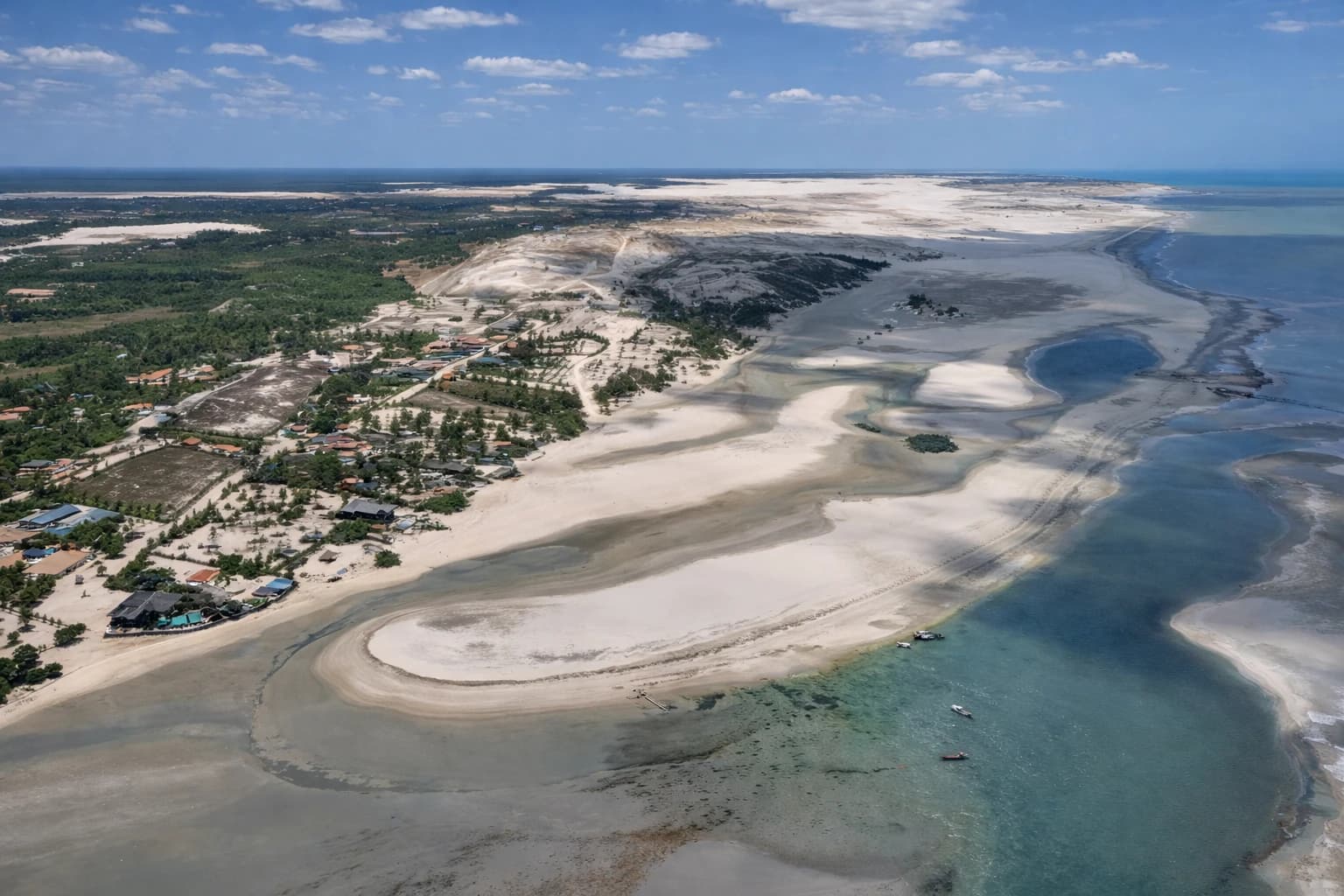
Tatajuba is a small fishing village in the municipality of Camocim, about 25 km from the town center along a sand track. Isolated between shifting dunes and the Guriú River delta, it was for decades just a lunch stop on kite downwinders from Jericoacoara toward Piauí. In recent years, it became a destination in its own right — first for its wind reputation, then for Duna do Funil and the lagoon circuit. It sits on the Ceará leg of the Route of Emotions itinerary, between Jericoacoara and Camocim, which is why most people still arrive on a downwinder and leave the same afternoon.
The village itself is small and simple. The streets are unpaved, the houses belong to fishermen, and the pace is slow even at the peak of kite season. There are basic guesthouses and a few camps geared toward kitesurfers, but nothing resembling the resorts of the more touristic coast.
What you'll find:
- 17–30 knot winds with 99% probability between July and February — peaking in September and October
- Duna do Funil: about 60 meters tall, one of the tallest dunes on the Ceará coastline — sandboarding (esquibunda, a wooden sled) is the main activity
- Lagoa Grande: warm freshwater lake with hammocks, zipline, water slide, and seasonal kiosks
- Guriú River mouth: flat water kite spot for freestyle at high tide
- Vila Nova Tatajuba: village rebuilt after the original was buried by dunes between 1970 and 1980
- ACOMOTA: community tourism association with local guides, cooks, and handicrafts
What you WON'T find:
- ATM — bring cash
- Reliable cell signal — only Vivo works in some spots, and not always
- Wi-Fi outside the guesthouses
- Pharmacy, supermarket, or urban services of any kind
- Paved access — the road is 100% sand
When to Go
| Period | What to Expect |
|---|---|
| Sep–Oct | Absolute kite peak — strong, steady winds with 30+ knot gusts possible. Historic home of the BAKL TatajubaFest (confirmed editions in 2020, 2021, and 2022). Less crowded than Jeri |
| Jul–Aug | Start of the strong season — consistent 17–23 knots, 2 extra months of wind compared to the Fortaleza corridor spots. Great for intermediate riders |
| Nov–Dec | Season still active, winds starting to ease. Best balance between conditions and access |
| Feb–Jun | Kite off-season. More rain (especially Mar–May). Lagoa Grande is usually full and beautiful. Village nearly empty of tourists |
Tip: If your goal is extreme kite, go in September or October. If you want to see Lagoa Grande at maximum volume and avoid the Passeio Oeste crowds from Jeri, go in March or April — the wind drops, but the scenery makes up for it.
How to Get There
Reference airports: Jericoacoara (JJD) and Camocim (no regular flights — use JJD or Fortaleza)
Tatajuba has no conventional road access. Both routes are on sand, and both require a suitable vehicle or organized transfer.
From Jericoacoara (most common route for tourists)
The overland route from Jeri to Tatajuba is about 25–30 km along sand trails and dunes, with a ferry crossing over the Guriú River (2025 reference prices: R$35 for motorcycle/quad, R$50 for buggy, R$70 for car or UTV — confirm locally on arrival). The buggy ride takes an average of 45 minutes to 1 hour, depending on tide and sand conditions.
This is also the route of the Passeio Oeste (West Circuit), the most famous excursion from Jericoacoara, which includes Mangue Seco beach, the river crossing, and stops in Tatajuba. Those doing it as a day trip leave in the morning and return by late afternoon.
Along the way, the Passeio Oeste passes through Mangue Seco and the Guriú River mangrove, where some local boatmen offer stops to observe seahorses. It's a seasonal excursion, tide-dependent and with no fixed price — arrange it on the spot with the boatman and avoid handling the animals.
Experienced kitesurfers make the trip as a downwinder — about 25–30 km by sea, which requires solid preparation and ground support logistics.
From Camocim (alternative route)
From Camocim, it's approximately 25 km along the beach and sand trail, with a ferry crossing of the Coreaú River. This route is mainly used by those coming from Piauí or doing the kite safari in the Barra Grande → Tatajuba → Camocim direction.
From Jericoacoara Airport (JJD)
JJD Airport is about 30–33 km from central Jericoacoara, and from there to Tatajuba is another 25–30 km of sand — totaling approximately 55–60 km of travel. Arrange your transfer in advance: there is no public transport and regular taxis don't reach the village.
Tip: The Guriú River ferry crossing depends on the tide — arrange your transfer in advance and confirm the timing with your guesthouse or operator. Track wind and tide in real time at rotainsider.com/condicoes.
What to Do
1. Duna do Funil — Sandboarding on One of the Ceará Coast's Largest Dunes
Duna do Funil stands about 60 meters tall and is cited by multiple sources as one of the tallest dunes on the Ceará coastline. It sits along the route to Tatajuba, on the Passeio Oeste circuit, and the stop is a must.
The main activity is esquibunda — sliding down seated on a small wooden sled, Ceará's version of sandboarding. Sled rental costs around R$10. There are also quads that pick up riders from the base for those who don't want to climb back up on foot (around R$5 per person). These are ballpark figures — confirm on arrival.
From the top, the view is spectacular: white dunes alternating with green oases, the Atlantic horizon on one side and the river floodplain on the other. Climb slowly — it's genuinely tall.
The Passeio Oeste from Jeri includes Duna do Funil, and shared transport (jardineira) costs from ~R$100 per person, depending on occupancy (confirm on arrival). Private buggy: ~R$500–650 per vehicle (seats up to 4 passengers).
2. Lagoa Grande — Warm Water, Zipline, and Kiosks
Lagoa Grande is the final stop on the Passeio Oeste and the heart of the Tatajuba experience for non-kiters. It replaced the former Lagoa da Torta, which lost volume due to shifting rainfall patterns — Lagoa Grande is the active lagoon today.
It's a warm freshwater lake surrounded by vegetation. Around it you'll find seasonal kiosks serving fish, lobster, and shrimp. Paid activities — zipline, water slide, and sandboarding on the surrounding dunes — cost from ~R$20 per activity, usually with unlimited repeats (confirm on arrival). Kayaks and SUP are also available for rent.
If you're doing the Passeio Oeste, lunch is usually here — allow time for the lagoon, not just the dunes.
3. Extreme Kite — Guriú River Mouth and Lagoa Grande
Tatajuba is at once one of the most extreme and most complete spots on Brazil's northeast coast. There are three distinct areas for different levels:
- Guriú River mouth: Flat water for freestyle at high tide. Good for intermediate and advanced riders who want a trick session without waves.
- Tatajuba beach: 1–2 meter waves during the season, cross-shore wind. Spot for advanced riders.
- Lagoa Grande: Freshwater, slightly lighter wind than the beach. Great for beginners and lessons.
The official season runs from July to February, peaking in September–October. The BAKL TatajubaFest (Big Air Kite League), with editions held in 2020, 2021, and 2022, is one of the most radical big air events in Brazil — featuring jumps in 30+ knot winds.
Tatajuba is not recommended for absolute kite beginners. The wind is intense and rescue access is limited. Beginners should train in Jeri, Preá, or at Lagoa Grande itself in calmer conditions.
4. Vila Nova Tatajuba — The Village That Rose Again
Between 1970 and 1980, the original village of Tatajuba was gradually buried by dunes over the course of years. The fishing families were resettled in four new communities — São Francisco, Vila Nova, Nova Tatajuba, and Baixa Tatajuba — with "Vila Nova Tatajuba" being the main one.
Today, the village keeps the burial story alive and develops community-based tourism through ACOMOTA (Associação Comunitária de Tatajuba). The association organizes guided visits with residents, meals prepared by local cooks, and handicraft sales. It's a short stop on the Passeio Oeste itinerary, but one of the most authentic in the region.
Where to Eat
Tatajuba doesn't have restaurants in the conventional sense. The food options are very limited and vary considerably by season.
In the village
There are a few beach shacks and family-run kiosks serving fried fish, chicken, and rice with beans. They're not guaranteed to be open outside kite season (July–February), and the menus are simple. Don't expect a wine list or elaborate desserts — it's fisherman's food, good and honest.
ACOMOTA arranges meals with local cooks for groups arriving through community tourism. If you're visiting Vila Nova Tatajuba, ask your guide about lunch prepared in the village.
At Lagoa Grande
The seasonal kiosks around Lagoa Grande are the best lunch option on the Passeio Oeste route. They serve fresh fish, lobster, and shrimp. They operate mainly during high season (July–December) and holidays. The average price for a seafood dish for two is around R$80–150 — confirm locally.
Practical tip: Bring snacks and enough water for the day. Don't count on shops or markets in Tatajuba. If coming from Camocim or Jeri, stock up before departing.
Where to Stay
Accommodation in Tatajuba is limited and mostly geared toward kitesurfers. There are no large guesthouses, let alone hotels. The general standard is simple — functional rooms, breakfast included in most cases, Wi-Fi on the guesthouse premises.
| Type | Vibe | Ideal For |
|---|---|---|
| Basic guesthouses | Simple rooms, private bathroom, breakfast | Kitesurfers, backpackers, adventurous couples |
| Kite bungalows | Gear storage, neoprene drying area | Riders staying several days |
| Camps and shared lodging | Hammock-style or dormitory | Kite safari groups, budget travelers |
Prices vary considerably by season. In high season (Sep–Oct), demand exceeds supply — book in advance. Outside kite season, most guesthouses close or operate with reduced staff.
Tip: Outside high season, many guesthouses close or operate with reduced staff — confirm availability directly with the guesthouse before locking in your dates.
Plan your trip to Tatajuba
Tides, routes, vendors — everything you need to plan.
3
places mapped
2
access routes
Real-time tides
Insider tips
Know someone planning this trip? Send it their way.
Practicalities
- Cash and cards: there is no ATM — bring cash (the nearest is in Camocim). Some guesthouses accept cards, but don't count on it.
- Cell signal: Weak. Only Vivo works in some spots, and not always with data. Download offline maps before leaving.
- Wi-Fi: Only at guesthouses. Quality varies.
- Access: 100% sand trail. 4x4, buggy, or specialized transfer required. Regular cars can't make it.
- River crossing: The Guriú River ferry is a mandatory part of the route from Jeri — and the Coreaú River ferry from Camocim. 2025 reference prices: R$35 (motorcycle/quad), R$50 (buggy), R$70 (car/UTV) — confirm locally on arrival.
- Pharmacy / medical services: None in Tatajuba. The nearest care is in Camocim. In case of an accident, rescue may be slow.
- Best time: September–October for extreme kite. March–May for a full lagoon and peace.
- How long to stay: A day trip via Passeio Oeste covers the basics. For kite, plan at least 3–4 days. The village rewards those who stay.
FAQ
Is Tatajuba suitable for beginner kiters?
We don't recommend Tatajuba for those still learning. The wind is intense (17–30 knots) and gusty, rescue access is difficult, and there's no fully equipped kite school for beginners. Learners should prioritize Jericoacoara, Preá, or Tatajuba's own Lagoa Grande on calmer days. Intermediate and advanced riders will love it.
Is there an ATM in Tatajuba?
No. There is no ATM in Tatajuba or its immediate surroundings. The nearest one is in Camocim. Bring enough cash for your entire stay — accommodation, food, activities, and tips. Some guesthouses accept cards, but don't count on it.
How long does it take from Jericoacoara to Tatajuba?
By buggy or 4x4, the sand trail takes between 45 minutes and 1 hour, plus time for the Guriú River ferry crossing. The Passeio Oeste from Jeri goes to Tatajuba and back in a single day (morning departure, late afternoon return). If making the trip independently, arrange your transfer in advance — there's no regular transport.
What is Duna do Funil?
Duna do Funil is a dune about 60 meters tall, one of the tallest on the Ceará coastline. It sits on the route between Jericoacoara and Tatajuba, as part of the Passeio Oeste. The main activity is esquibunda — sliding down on a small wooden sled, rented for about R$10 (confirm on arrival). From the top, the view spans the Atlantic, white dunes, and green oases.
Is Tatajuba worth it for non-kiters?
Yes, but set your expectations accordingly. Duna do Funil and Lagoa Grande are memorable experiences for any traveler. The village itself has a genuinely off-grid charm — silence, fishermen, no mass tourism. But the logistics are demanding: no ATM, no signal, difficult access. If you want adventure and real isolation, it's absolutely worth it. If you want comfort and convenience, Jericoacoara is a better base.
Read Also
- Route of Emotions (Rota das Emoções) — The complete route of the kite-and-dunes corridor, from Ceará to Maranhão
- Camocim — The nearest town, with services and kite at the Coreaú River delta
- Jericoacoara — The hub of the west coast, starting point for the Passeio Oeste
- Bitupitá — Remote village further west, with deserted beaches and lagoons
- Barrinha — Small beach near Jeri, quieter
- Wind and tide conditions — Real-time forecast for planning your kite sessions and the Guriú River crossing
Last updated: August 2026