

Summary
| Item | Detail |
|---|---|
| What it is | Transit town. Logistics hub Delta ↔ Lençóis ↔ Atins |
| When to go | Any time for passing through. Jul–Jan for kite at Arpoador (peak Sep–Nov). Jun–Sep for full lagoons |
| How to get there | Parnaíba (PHB) ~121 km (~2h). Barreirinhas ~70 km / ~1h30 via coastal MA-315 (Cisne Branco bus ~2h) |
| How long to stay | 1 night for connections. 2–3 nights for Arpoador + Pequenos Lençóis |
| ATM | Yes — BB, BNB, Bradesco, Caixa (carry cash as backup) |
| Signal | Moderate — center OK; beaches and Delta unstable |
| Access to Atins | 4x4 ~1h40 (1h30–2h), ~60 km, tide-dependent |
Ready to plan? Talk to us — we live here and help you build your itinerary.
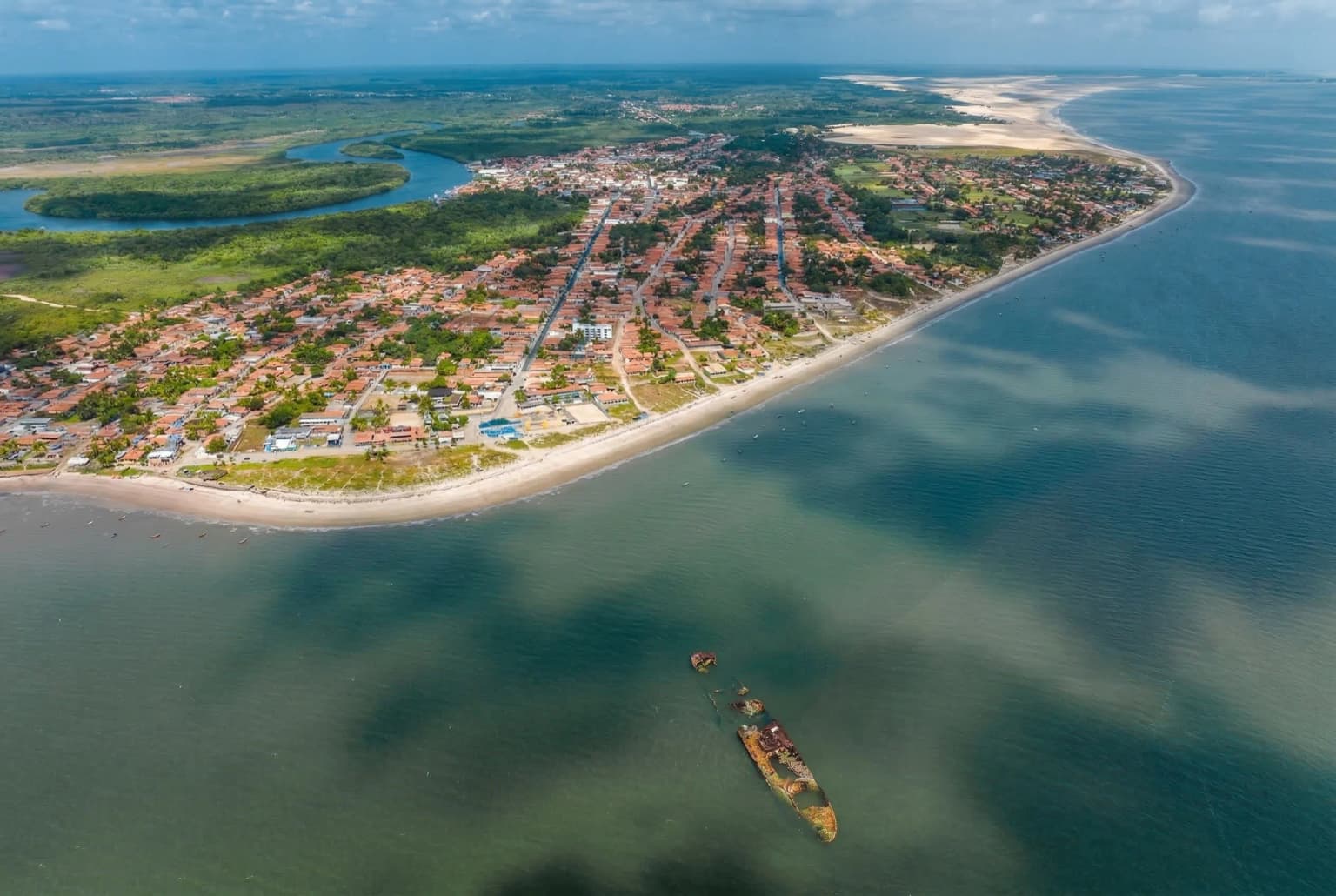
Tutóia is not a beach village to settle into — it's the obligatory waypoint between two of Brazil's most spectacular ecosystems. Anyone traveling the Rota das Emoções toward the Lençóis Maranhenses (or in the opposite direction) stops here to catch a bus, hire a 4x4 transfer to Atins, or wait for the tide to drop before crossing the Delta. Most travelers stay one night. Some stay longer — and understand why.
Quick summary: Transit town (~53,000 inhabitants, IBGE 2022). Logistics hub between the Parnaíba Delta and the Lençóis Maranhenses. Base for Praia do Arpoador (kite, lagoons, low-tide access). Gateway to Atins via off-road track.
What Tutóia Is
Tutóia is a mid-sized town at the far eastern edge of Maranhão, just a few kilometers from the Piauí border. It doesn't have the village charm of Atins or the kite energy of Barra Grande — it's a functional town, with supermarkets, gas stations, pharmacies, banks, and bus terminals.
What you'll find:
- Bus terminal with routes to Parnaíba, São Luís, and Barreirinhas
- 4x4 transfer pickup points for Atins (via beach and dunes)
- Access to the Parnaíba Delta from the Maranhão side — less crowded than the Piauí side
- Praia do Arpoador: kite spot with freshwater lagoons between the dunes, accessible only at low tide
- Praia do Amor: 3 km of pristine beach, considered the most beautiful in town, just past Arpoador
- Pequenos Lençóis Maranhenses: the lesser-known version of the Lençóis, with dunes and coconut palms, accessible by jeep
- Seafood-based cuisine — shrimp is the regional highlight
What you WON'T find:
- Established tourist infrastructure (guesthouses at kite-village standards)
- Nightlife or tourist-oriented street activity
- Direct access to the main Lençóis lagoons — for that you need to reach Barreirinhas
When to Go
| Period | What to Expect |
|---|---|
| Jul–Jan | Kite season at Arpoador: strong, consistent wind (18–28 knots). Sep–Nov is the peak. |
| Jan–Sep | The rains (Jan–Jun) fill the Pequenos Lençóis lagoons, which are fullest from June to September and start dropping from September. |
| Aug–Sep | Most complete window: kite wind building and lagoons still full — both at once. |
Tip: If you're just passing through, any time of year works — bus and transfer logistics run year-round. If you want to enjoy Arpoador or the lagoons, adjust your dates based on the table above.
How to Get There
Nearest airport: Parnaíba (PHB) — ~121 km by road (MA-034), approximately 2 hours by car.
Quick answer — how to get to Tutóia:
| Origin | ~km | ~time | How | Operator |
|---|---|---|---|---|
| São Luís | ~325 km | ~6h–7h | Direct bus | Cisne Branco, Expresso Guanabara |
| Parnaíba (PHB) (MA-034) | ~121 km | ~2h | Car, bus, or van | — |
| Barreirinhas (coastal MA-315, via Paulino Neves) | ~70 km | ~1h30 by car · ~2h by bus | Car, transfer, or bus | Cisne Branco (~4×/day) |
| Atins (4x4 via dunes/beach) | ~60 km | ~1h40 (1h30–2h) | 4x4 transfer, tide-dependent | Local operators |
From São Luís (direct bus)
From São Luís there's a direct bus to Tutóia: ~325 km by the most direct route, ~6h–7h depending on the departure time and the carrier — some routes run inland and take longer. The bus passes through Rosário → Morros → Barreirinhas → Paulino Neves before reaching Tutóia; the final stretch on the coastal MA-315, after Barreirinhas, is usually the slowest part of the trip. The Cisne Branco and Expresso Guanabara lines run the route, with several daily departures — check schedules at the São Luís bus station on the day of travel.
From Parnaíba (the most common route)
Most travelers arrive in Tutóia from Parnaíba, after one or more days at the Parnaíba Delta or Barra Grande (PI). The MA-034 highway is paved for nearly its entire length. From Parnaíba, there are regular buses to Tutóia — check schedules at the Parnaíba bus station on the day of travel, as times change by season. It's ~121 km and about 2 hours of travel. Taxis and private vans do door-to-door transfers and are more practical with luggage.
From Barreirinhas (coming from the Lençóis Maranhenses)
Since the coastal highway MA-315 opened (Barreirinhas–Paulino Neves–Tutóia, in 2019), the normal route is short: ~70 km, about 1h30 by car or transfer, passing through Paulino Neves. By bus, the Cisne Branco line covers it in ~2h, with about 4 departures a day. There's also a longer interior route, useful in heavy rain when the coastal one bogs down in sand — but the coastal route is the normal one. For those traveling toward the Delta and the Rota das Emoções, Tutóia is the first relevant stop after Barreirinhas — from there, the final destination is usually Parnaíba, Barra Grande, or directly Atins.
From Atins (4x4 transfer)
Atins has no conventional road access. The transfer between Tutóia and Atins is done by 4x4 vehicles crossing dunes and beaches for about 60 km. Duration is ~1h40 (range of 1h30 to 2h) under normal conditions. Transfers depend on tides — check with local operators to confirm departure time on the day, and track wind and tide in real time at rotainsider.com/condicoes.
What to Do
1. Praia do Arpoador — Kite, Lagoons, and Low Tide
Tutóia's best-known attraction is about 20 km from the center, accessible only by 4x4 and only at low tide — when the sand strip between the ocean and the lagoons allows passage. On site: the silence of a beach that hasn't been overtaken by mass tourism. Access is via Barra (a coastal neighborhood of Tutóia), with a transfer time of about 20 minutes from the waterfront.
The freshwater lagoons are Arpoador's second star. They form between the dunes during the rainy season (January to June), when rain percolates through the sand and collects over the impermeable sedimentary rock of the Barreiras Formation — the same geological process that creates the Lençóis lagoons. The water is crystal-clear, fresh, and refreshing, varying in shades of green and blue. The lagoons are fullest from June to September; from September they begin to drop. You can swim, sandboard into the lagoons (esqui-bunda), and walk among the dunes.
Arpoador is also a kite spot, with flat water between the sandbanks at low tide and waves at high tide. Season, water, schools and downwinds live in the dedicated guide — Kitesurfing at Arpoador (Tutóia) — and the day's conditions at rotainsider.com/condicoes.
Warning: Don't try to get there in your own car. Crossing at the wrong tide can strand your vehicle. Hire an experienced local driver or book an organized tour.
2. Praia do Amor — The Most Beautiful Beach in the Area
Just past Arpoador, Praia do Amor stretches 3 km and is considered the most beautiful open-ocean beach in Tutóia — its name comes from being the favorite retreat for couples seeking nature and seclusion. Pristine and practically deserted outside the summer season, the beach has natural pools that form with the tide variation and strong wind that attracts wave-riding kitesurfers. There's no commercial infrastructure — bring water and food.
The sunset here is one of the most cited by visitors. The best vantage point is the Mirante do Maceió, atop a dune at the end of the Circuito Praias, overlooking Lagoa do Maceió and the meeting point of the Delta with the Pequenos Lençóis. The Duna do Pôr do Sol, more accessible (~15 minutes on foot from Praia do Félix), offers a panoramic view from ~30 m elevation. The beach is about 26 km from the center, in the direction of Paulino Neves via the MA-315.
3. Pequenos Lençóis Maranhenses — Dunes with Coconut Palms
The Pequenos Lençóis Maranhenses form an APA (Environmental Protection Area) adjacent to the main Lençóis. The standout difference: here the dunes coexist with coconut palms — the "oasis" landscape that the Barreirinhas Lençóis don't have. Access is by jeep along the jardineira track, with lagoons at their fullest between June and September. Half-day circuits depart from Tutóia (or Barra), covering ~20 km of off-road terrain.
4. Connection to Atins via the Dune Road
For many travelers, the main reason to pass through Tutóia is the transfer to Atins — the most remote village on the Rota das Emoções, with no paved road. The route crosses beaches, dunes, and lagoons for about 60 km, taking ~1h40 (range of 1h30 to 2h) depending on conditions. The transfer itself is already an experience: the landscape between Tutóia and Atins is one of the most stunning on the Maranhão coast.
Where to Eat
Tutóia is known as the "Land of Shrimp" — and the reputation is well-deserved. The cuisine revolves around seafood, with local shrimp celebrated for its texture and flavor, a result of the natural habitat in the Delta's estuaries. Don't expect sophistication: these are simple restaurants frequented by locals, with short menus based on the day's catch.
What to eat
- Camarão no abacaxi — Tutóia's signature dish: shrimp with garlic, salt, onion, and cream, served inside a hollowed-out pineapple topped with dried shrimp, bell pepper slices, tomato, and olives. The most talked-about dish among visitors
- Camarão no bafo — steamed shrimp with regional seasonings
- Camarão assado na brasa — simple preparation with coarse salt, straight on the grill
- Moqueca de camarão — stew with coconut milk, served with rice and pirão
- Caranguejo — the second flagship product, prepared in various styles
- Farofa de camarão e anchova — specialty from shacks at Praia da Barra
- Galinha caipira — free-range chicken served at the river circuit balneários, with rice and beans
In central Tutóia: Per-kilo restaurants, snack bars, pizzerias, and grills for quick meals before or after a bus connection — adequate for those passing through. There are options for grilled meat portions, artisan pizzas, and live music at some bars.
At Praia da Barra: Shacks and seafood restaurants on the waterfront, with tables on the sand and views of the Tutóia bay — the last bay of the Parnaíba Delta. Colorful fishing canoes complete the scenery.
At Arpoador: On-site restaurant with seafood options. It's the only structured food point in the beach area.
At Barra (Arpoador access point): some guesthouses with restaurants serve the camarão no abacaxi as their signature dish. To have lunch without being a guest, it's worth booking ahead — confirm on the spot.
Price range: R$35–70 per main course at sit-down restaurants. Per-kilo meals in the center from R$25.
Where to Stay
Tutóia is not an accommodation destination — it's a connection stop. The number of guesthouses is limited and the standard is simple. For most travelers, one night is enough.
| Zone | Vibe | Best For |
|---|---|---|
| Center | Practical, close to the bus station and shops | Travelers in transit, bus arrivals/departures |
| Barra / Arpoador | Rustic, on the off-road beachfront | Kitesurfers, those who want to explore Arpoador |
In the Barra area, there are guesthouses with basic accommodation (rooms with air conditioning, breakfast, parking) aimed primarily at kitesurfers who use Arpoador as a base for a few days. Options in the Arpoador area have Wi-Fi, on-site restaurant, and organize transfers to the beach.
Price range: from ~R$150 per night at simple guesthouses (up to ~R$350). Guesthouses with kite infrastructure at Arpoador (lodging + kite school): prices on request, usually with transfers and lesson packages.
Accommodation: prices vary by category, season, and availability.
Plan your trip to Tutóia
Tides, routes, vendors — everything you need to plan.
3
places mapped
2
access routes
Real-time tides
4
verified vendors
Know someone planning this trip? Send it their way.
Practicalities
- ATM: Yes — Banco do Brasil, Banco do Nordeste, Bradesco, and Caixa Econômica in the center (may be out of service — carry cash as backup)
- Cell signal: Moderate — 4G available in the center and on the access roads; beaches and the Delta have unstable or no signal
- Wi-Fi: Available at guesthouses; limited outside of them
- Main access: Paved highway MA-034 (Parnaíba–Tutóia, no vehicle restrictions); coastal route MA-315 (Barreirinhas–Tutóia) via Paulino Neves, subject to sand/maintenance
- Beach access (Arpoador, Amor): Off-road, 4x4 required, depends on low tide
- Tutóia–Atins transfer: 4x4, ~1h40 (1h30–2h), ~60 km, tide-dependent — confirm time on the day
- Fuel: Gas stations in central Tutóia
- Pharmacies and supermarkets: Available in the center
Warning about crossing to Arpoador: Access is via the sand strip between the ocean and the lagoons — only possible at low tide. Regular vehicles will get stuck. Don't improvise: hire a local driver or book an organized tour.
Frequently Asked Questions
How long should I stay in Tutóia?
For those just passing through (catching a bus to Barreirinhas or a transfer to Atins), one night is enough — or even less, depending on connection times. For those who want to see Arpoador and the Pequenos Lençóis lagoons, 2 to 3 nights allow you to do both circuits without rushing. More than that is rare: most of the major attractions are 20–30 km from the center.
Is Tutóia safe?
Yes, by the standards of interior Maranhão. It's a functional town with mid-sized city infrastructure. The beaches outside the center (Arpoador, Amor) are deserted and require a guide or local driver — not for safety reasons, but for logistics (off-road access, tides). Use the same precautions as in any town in the Brazilian Northeast interior.
Can I skip Tutóia on the Rota das Emoções?
It depends on your itinerary. For those traveling between Parnaíba and Barreirinhas directly by bus, Tutóia is a mandatory technical stop — there's no way to bypass it on the overland route. For those heading straight to Atins (the transfer departs from Tutóia or Paulino Neves), it can't be avoided either. Those arriving in Atins by boat through the Delta can bypass Tutóia, but that's the exception.
How does the Tutóia to Atins transfer work?
The transfer is done by 4x4 vehicles that cross the beaches and dunes between Tutóia and Atins — approximately 60 km of off-road terrain. Duration is ~1h40 (range of 1h30 to 2h). Departure time is determined by the tide: the vehicle only leaves when the low-tide window allows the crossing. There are generally departures in the early morning and, on some days, in the late afternoon. Confirm times directly with operators the day before.
Is there a direct bus from Tutóia to Barreirinhas?
Yes. The Cisne Branco line runs the Tutóia–Barreirinhas route along the coastal road (MA-315, via Paulino Neves) in about 2 hours, with roughly 4 departures a day. By car, van, or private transfer, it's ~70 km and about 1h30. Check schedules at the Tutóia bus station on the day.
Read Also
- Route of Emotions: the complete itinerary — the Jericoacoara → Delta → Lençóis corridor end to end
- Parnaíba — Gateway to the Rota das Emoções, delta, and diving
- Barra Grande PI — Beach clubs and nightlife across the border in Piauí, ~181 km from Tutóia
- Barreirinhas — Main base for the Lençóis Maranhenses
- Paulino Neves — Small village between Tutóia and Barreirinhas, secluded lagoons
Last updated: August 2026