

Summary
| Item | Detail |
|---|---|
| What it is | Ecotourism village with a manatee sanctuary and the Cajueiro Rei |
| When to go | Year-round for manatees; Jul–Dec for natural pools |
| How to get there | Parnaíba (PHB) ~68 km (~1h by car via BR-402) |
| Highlight | Only open-ocean manatee monitoring program on the planet |
| ATM | No — bring cash |
| Signal | Moderate (4G TIM/Oi/Vivo in most of the village) |
| Distance from Barra Grande | ~8 km (~15 min by car) |
Ready to plan? Talk to us — we live here and help you build the itinerary.
Cajueiro da Praia holds two rare titles at the same address: the only open-ocean manatee monitoring program on the planet and the Cajueiro Rei, a living organism approximately 200 years old with over 8,800 m² of canopy — a Guinness candidate. About 8 km from Barra Grande, the village is quiet, affordable, and genuinely committed to community-based ecotourism.
Quick summary: Piauí's manatee capital. Community ecotourism. Peaceful beach. Natural pairing with Barra Grande.
What Cajueiro da Praia Is
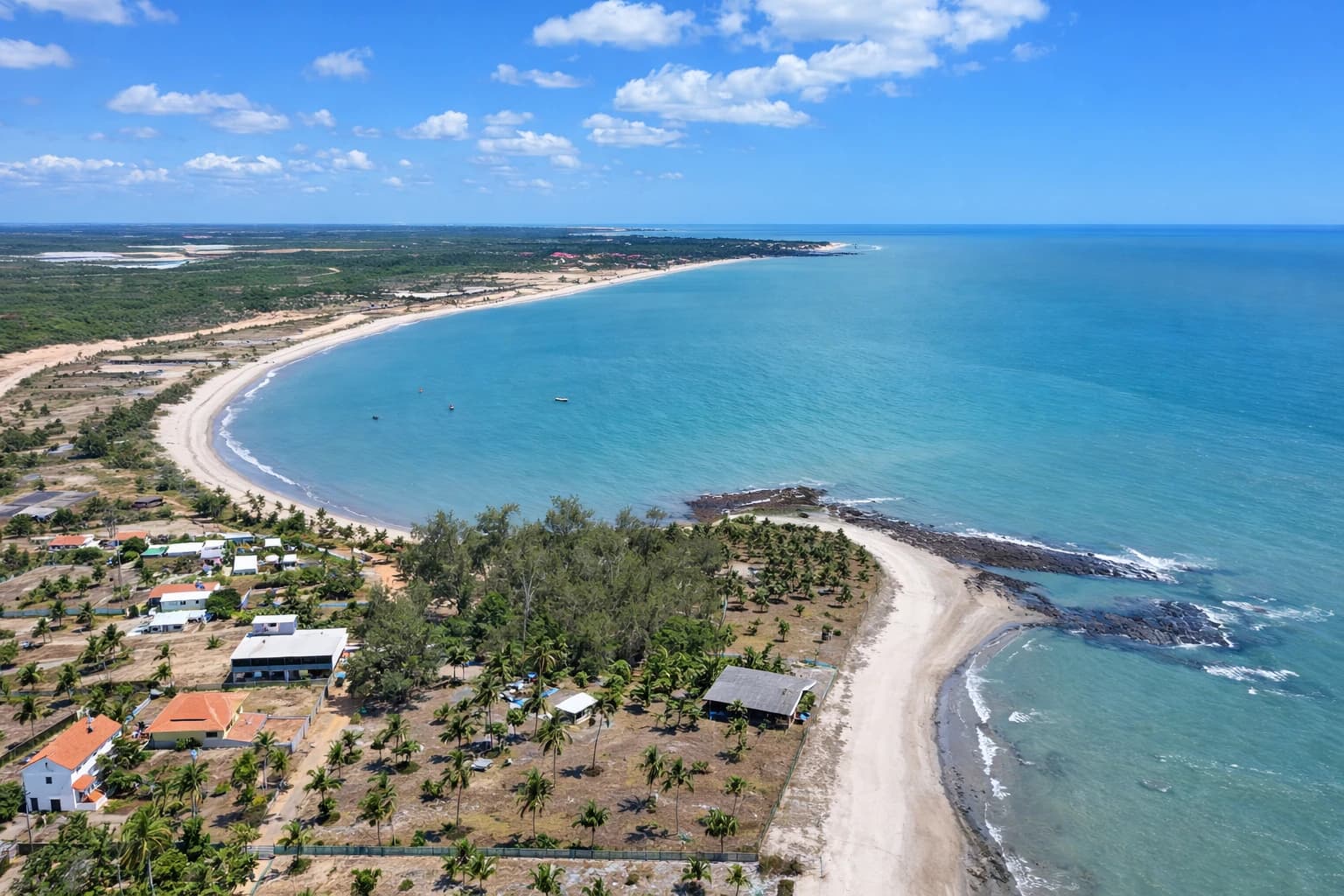
Cajueiro da Praia is a small coastal municipality in Piauí, tucked into the corridor between Parnaíba and Barra Grande. It's one of the few villages in Brazil where tourism exists almost entirely around an active conservation project: the Marine Manatee Sanctuary, managed by ICMBio, which monitors the Trichechus manatus manatus population along the Piauí coast.
What you'll find:
- Guided sailboat canoe tours for manatee observation in natural habitat — motorboats are prohibited to avoid disturbing the animals
- ICMBio museum and environmental education center — Centro de Mamíferos Aquáticos (CMA/ICMBio)
- The Cajueiro Rei: a single organism confirmed by DNA sequencing (UESPI/LABMIMBIO), with a canopy of 8,832 m² according to official study — protected by Municipal Law No. 292/2013
- Piscinas Naturais de Tombo, accessible at low tide between July and December
- Long, uncrowded beach with no mass-tourism shacks
- Easy access to Barra Grande (~8 km)
What you WON'T find:
- ATM — bring cash from Parnaíba or Luís Correia
- Extensive tourist infrastructure — restaurants and guesthouses are few and simple
- Public Wi-Fi — only at guesthouses
- Structured kite or surf — that's Barra Grande and Macapá's role
When to Go
| Period | What to Expect |
|---|---|
| Year-round | Manatee canoe tour (R$100/person) — depends on tide, departures preferably in the morning |
| Jul–Dec | Piscinas Naturais de Tombo accessible at low tide — crystal-clear water over stone reef |
| Sep–Dec | Stronger and more consistent winds; dry heat; best pairing with kite at Barra Grande (~8 km) |
| Jan–Jun | Periodic rains, fewer tourists, lower prices — the manatee tour keeps running |
Tip: The canoe tour depends on the tide. Tours depart with accredited community guides, in the area monitored by ICMBio — book in advance through your guesthouse or a local guide and confirm the departure time the day before — generally early morning, when the animals are most active at the surface.
How to Get There
Nearest airport: Parnaíba (PHB) — ~68 km, approximately 1 hour by car.
From Parnaíba, the main route follows the BR-402 — the coastal highway linking Parnaíba to Chaval, passing through Camurupim — and then a state/local road to Cajueiro da Praia. The access is entirely on paved road — no sand stretches or ferry crossings along the way.
From Parnaíba: Most visitors arrive by private car, rental car (available at PHB airport), or private transfer booked in Parnaíba. The journey takes 50 to 70 minutes depending on the stretch. There is no direct bus line with frequent schedules.
From Barra Grande: Cajueiro da Praia is 8.4 km from Barra Grande on paved road — less than 15 minutes by car. It's common to stay in Barra Grande and visit Cajueiro da Praia for a morning, especially for the manatee tour.
From Luís Correia: About 30 km, approximately 35 minutes by car, via coastal road.
What to Do
1. Manatee Canoe Tour (Marine Manatee Sanctuary)
The main reason to come to Cajueiro da Praia is unique on the planet: observing manatees (Trichechus manatus manatus) in open ocean, in completely natural habitat, aboard traditional sailing canoes — no motors, to avoid disturbing the animals. Tours depart with accredited community guides, in the area monitored by ICMBio, one of the largest marine manatee refuges in Brazil.
The tour costs R$100/person and lasts about 1 hour, which can vary depending on the tide and route. Morning departures are most common. Small groups, minimum 2 people. Book in advance through your guesthouse or an accredited local guide.
Separate from the canoe tour, the Centro de Mamíferos Aquáticos (CMA/ICMBio) has a museum with exhibits on manatee biology, a science room, and a screening room. Admission: R$10/person. Open daily.
2. Cajueiro Rei
Two kilometers from the village center stands the Cajueiro Rei — a single living cashew tree organism (Anacardium occidentale) approximately 200 years old, whose canopy spans 8,832 m² through natural vegetative propagation (branches that touch the ground, root, and generate new trunks, all genetically identical, confirmed by DNA sequencing from UESPI/LABMIMBIO). The municipality submitted documentation to Guinness World Records in September 2021 to challenge the record held by the Cajueiro de Pirangi (RN), but official recognition is still pending.
The visit includes a ~1 km trail (about 40 minutes), environmental interpretation, and a sales area for regional products — cashews, sweets, and crafts. Admission: R$7/person. Children under 7: free. Hours: 7:30 AM–5:30 PM.
3. Praia de Cajueiro and Piscinas Naturais de Tombo
The beach at Cajueiro da Praia is long, uncrowded, and free of mass-tourism infrastructure. Good for walks, peaceful swims, and contemplation. Between July and December, the Piscinas Naturais de Tombo become accessible at low tide — natural pools formed over stone reef with crystal-clear, turquoise water, ideal for basic snorkeling. Access is on foot along the beach; check the tide schedule before heading out — follow the tide at rotainsider.com/condicoes.
4. Kayaking and Mangrove Exploration
The estuary around Cajueiro da Praia has waterways threading through mangroves — habitat of the manatees and various bird species. Kayak or canoe tours through the mangrove can be arranged locally with community guides. The experience complements the mammal observation tour and offers another perspective on the ecosystem that makes the region unique.
5. Seahorse-Watching Tour
Beyond the manatee, the region is known for its own seahorse-watching tour, done by canoe through the Camboa and the estuary's mangroves — it usually lasts about 2 to 3 hours. It's a distinct program from the manatee tour and also depends on the tide, generally arranged locally with community guides. Seahorses are small and discreet, so it's worth bringing patience and always following the guide's instructions to avoid disturbing the animals.
6. Day Trip to Barra Grande (~8 km)
Barra Grande is 8.4 km away on paved road — a natural pairing. There you'll find more varied restaurants, kite, windsurf, Lagoa La Boca, and more nightlife. Many visitors stay in Cajueiro da Praia (quieter and cheaper) and spend the day in Barra Grande for activities and meals.
Where to Eat
The dining options in Cajueiro da Praia are limited — the village is small and doesn't have Barra Grande's infrastructure. But what exists is honest and well-located.
Meals in the Village
There are a few simple restaurants and beach shacks serving fresh fish, seafood, and regional Piauí cuisine — rice, beans, carne de sol, caldeirada. Prices are low (R$25–50 per main course). Irregular hours outside peak season.
Local Products
At the entrance to Cajueiro Rei there's a sales area for regional products: fresh and roasted cashews, fruit preserves, and local crafts — worth stopping for and taking some for the road.
Practical tip: For more varied dining and restaurants with a proper menu, head to Barra Grande (15 min by car). The food scene there is significantly larger and includes international options.
Where to Stay
Cajueiro da Praia has few accommodation options — all simple, family-run, and geared toward ecotourism. Prices are lower than Barra Grande.
| Profile | Vibe | Best For |
|---|---|---|
| Eco-guesthouses in the village | Simple, close to ICMBio and the beach | Those who want quiet and a focus on the manatees |
| Stay in Barra Grande | More infrastructure, ~8 km away | Those who want to combine kite and manatees |
Most village guesthouses have rooms with air conditioning, basic Wi-Fi, and breakfast included. Advance booking recommended in July/August and October/November (corridor high seasons).
Prices: vary by category and season. Platforms like Booking.com have verified listings for the region.
Plan your trip to Cajueiro da Praia
Tides, routes, vendors — everything you need to plan.
2
places mapped
2
access routes
Real-time tides
Insider tips
Know someone planning this trip? Send it their way.
Practicalities
- ATM: None in Cajueiro da Praia — there's no ATM, bring cash. Withdraw in Parnaíba or Luís Correia before arriving.
- Cards: Accepted at larger guesthouses; not always accepted at restaurants and local shacks. Have cash on hand.
- Cell signal: Moderate — 4G available from TIM, Oi, and Vivo in most of the village. May fail at points further from the center and in the estuary during the tour.
- Wi-Fi: Only at guesthouses. No public Wi-Fi.
- Access: Paved road via BR-402 and state/local road. No 4x4 or ferry required.
- Manatee tour: Book in advance — limited groups, minimum 2 people — through your guesthouse or an accredited local guide. Departure time depends on the tide and is confirmed the day before.
- Cajueiro Rei: Admission R$7/person, children under 7 free. Hours 7:30 AM–5:30 PM. Bring sunscreen — much of the trail is exposed.
- ICMBio Museum (CMA): Admission R$10/person. Good option before or after the canoe tour.
- Recommended strategy: Stay in Cajueiro da Praia (cheaper and quieter), do the manatee tour in the morning, and spend the afternoon in Barra Grande. Or stay in Barra Grande and come early in the morning for the tour.
Frequently Asked Questions
Does the manatee tour run year-round?
Yes. The Marine Manatee Sanctuary operates with daily departures throughout the year. The time varies based on the tide — generally early morning, when the animals are most active at the surface. Book in advance, as groups are small (minimum 2 people). The sailing canoe tour costs R$100/person; the ICMBio museum is R$10 separately.
Is there an ATM in Cajueiro da Praia?
No. There is no bank or ATM in the municipality — bring cash from Parnaíba or Luís Correia before arriving. Cards are accepted at larger guesthouses, but not always at restaurants and shacks.
Is Cajueiro da Praia worth visiting even without doing the manatee tour?
Yes — the Cajueiro Rei alone justifies the visit for anyone interested in nature and botanical curiosities. The beach is beautiful, peaceful, and uncrowded. And the pairing with Barra Grande (~8 km) makes the detour easy to fit into any Delta itinerary.
What's the difference between the Cajueiro Rei in Cajueiro da Praia and the Cajueiro de Pirangi (RN)?
They are two completely distinct organisms, about ~1,000 km apart. The Cajueiro de Pirangi (RN) has held the Guinness record since 1994 with approximately 8,500 m². The Cajueiro Rei in Cajueiro da Praia (PI) is ~200 years old, with a canopy measured at 8,832 m² by official UESPI research using GPS, confirmed as a single organism by DNA sequencing. The municipality submitted its Guinness candidacy in 2021; formal recognition has not yet been published.
Cajueiro da Praia or Barra Grande: where should I stay?
It depends on your priority. Cajueiro da Praia is quieter, cheaper, and makes sense if the manatee tour is your focus. Barra Grande has more restaurants, kite, and nightlife. The two are ~8 km apart — many travelers split their stay or base themselves in Barra Grande and visit Cajueiro da Praia for a morning.
Read Also
- Route of Emotions (Rota das Emoções) — The complete corridor itinerary: Jericoacoara → Parnaíba Delta → Lençóis
- Barra Grande PI — Livelier beach village ~8 km away: restaurants, nightlife, and kitesurfing
- Luís Correia — City with ATMs and services, logistics base for the corridor
- Parnaíba — Entry point via the Delta, PHB airport
- Ilha das Canárias — Quilombola community in the heart of the Delta
Last updated: July 2026