

Summary
| Item | Detail |
|---|---|
| What it is | Authentic fishing village with flat water kite, photogenic Mangue Seco, and seahorse nursery |
| When to go | Jul–Dec for kite (peak Sep–Nov); Mar–Jun for nature and solitude |
| How to get there | From Jeri: ~30 min by buggy along the beach. From JJD Airport: ~1h–1h30min |
| What sets it apart | Flat water for kite, subject to the day's conditions; preserved authenticity |
| ATM | No — bring cash |
| Signal | Weak (Vivo, inconsistent) |
| Ferry | Dawn to ~6pm (check tides) |
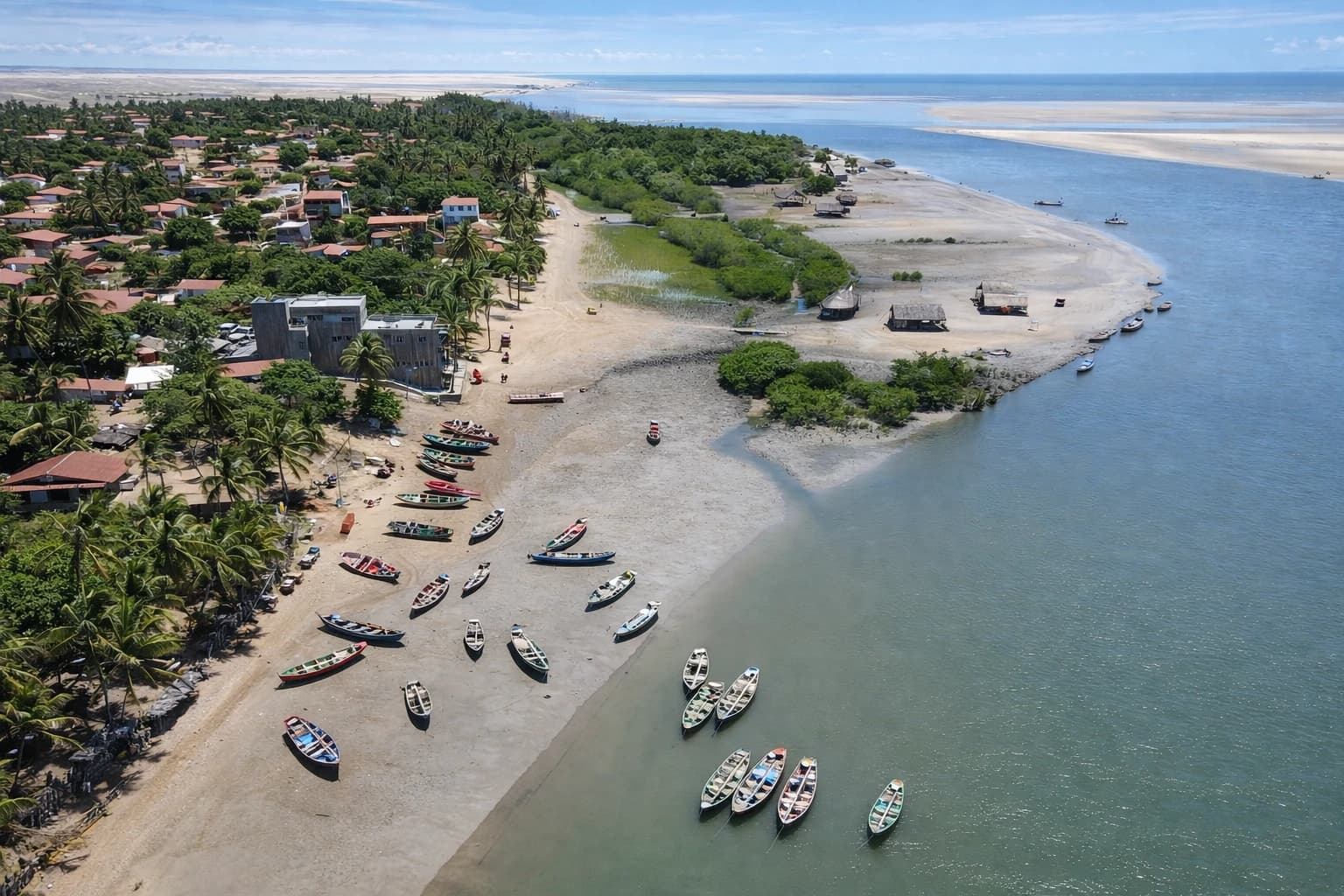
Guriú is one of the most authentic villages on the entire Rota das Emoções (Brazil's Route of Emotions). Just a few kilometers from Jericoacoara but already within the municipality of Camocim, it stayed off the mass tourism circuit for decades — and that distance is exactly what preserved it. The ferry crossing over the Rio Guriú, the wind-swept white sands, the cinematic Mangue Seco, and the flat water at the river mouth have created, in recent years, a discreet and loyal kitesurfing community. Those who come once, come back.
Quick summary: Authentic fishing village. Flat water for kiting at the river mouth. Photogenic Mangue Seco. Seahorse nursery in the estuary.
What Is Guriú
Guriú is a fishing village on the west coast of Ceará, nestled between the dunes of Jericoacoara National Park and the Rio Guriú estuary. With fewer than a thousand permanent residents, it combines two worlds: the slow daily life of fishermen who head out before dawn, and the growing energy of a kite destination that's beginning to appear on international radars.
The geographical heart of the village is the mouth of the Rio Guriú — where the river creates a flat water lagoon sheltered from ocean chop. On the opposite bank, the twisted trees of Mangue Seco form one of the most photographed scenes on the Ceará coastline. This is also where populations of seahorses (Hippocampus reidi) studied by marine researchers live.
What you'll find:
- Sheltered flat water for kitesurfing, with variable wind and water subject to tidal variation
- Mangue Seco with cinematic scenery — dry branches over sand, swings, and unique views
- Seahorse nursery in the Rio Guriú estuary — canoe tour
- Strong-wind beach with a wide strip of white sand
- Active fishing village, local pace, no mass tourism chains whatsoever
- Transit point for the Jeri–Camocim ferry crossing
What you WON'T find:
- ATM — bring cash
- Reliable cell signal (Vivo works in some spots, not always)
- Wi-Fi beyond the guesthouses
- Varied restaurants and shops — options are minimal
- Access without a buggy or 4x4
When to Go
| Period | What to Expect |
|---|---|
| Jul–Dec (peak Sep–Nov) | A popular period for kite. Wind, tides and the space available for riding vary; check the day's conditions with a local school. |
| Jan–Feb | Winds weakening. Kite still possible on some days, but no guarantee. Transition to the rainy season. |
| Mar–Jun | Rainy period — Mangue Seco turns lush green and becomes even more photogenic. A more introspective trip: less kite, more fishing and nature. |
Planning tip: July to December is a useful window for planning a kite trip, with a peak from September to November. Wind strength and duration vary; check the forecast and agree on a time with a local school. For those who just want the village and Mangue Seco, March to May has fewer tourists and lush post-rain scenery.
How to Get There
Nearest airport: Jericoacoara (JJD) From Jeri to Guriú: ~10 km / 30 minutes by buggy along the beach From Jijoca de Jericoacoara to Guriú: ~45 minutes by buggy or 4x4
From Jericoacoara
The most common route heads west from Jericoacoara, along the shoreline and across the National Park dunes. The entire stretch is on sand — there is no paved road between Jeri and Guriú. Private buggy (up to 4 people) or shared 4x4 are the only options. Some transfers depart from Jijoca de Jericoacoara, the nearest urban center, about 20 minutes by road from JJD Airport.
The stretch includes the ferry crossing over the Rio Guriú, which operates from dawn until approximately 6pm. If it's a day trip, note the return schedule.
From JJD Airport
Jericoacoara Airport (JJD) is in the municipality of Cruz. It is about 30 km from Jeri by road and another 10 km of sand to Guriú. The total journey from the airport to Guriú takes approximately 1h to 1h30min, depending on the transport hired. Transfers leave from Jijoca directly to the village (less common) or do Jijoca–Jeri–Guriú as part of a Rota das Emoções shuttle.
From the Camocim side
Those coming from Camocim (west) arrive on the CE-313 or along the sand track that runs through Tatajuba. This is the traditional direction — Camocim to Guriú to Jeri — of the Rota das Emoções itinerary.
Logistics note: The ferry does not operate at night and may have reduced hours outside the tourist season — confirm before planning late-day arrivals or departures.
What to Do
1. Kitesurfing on Flat Water
The Guriú lagoon is a flat water spot in the Jericoacoara region. While the ocean beach has chop and waves, the Rio Guriú estuary offers flat water at standing depth with 15–25 knot winds in the season (July to December), depending on the day's conditions. It's the favorite spot for freestylers. If you're a beginner, check with the school about depth, currents, tides and obstacles, and which area suits your level. Shallow water does not guarantee safety.
The local kite school offers courses for all levels, private lessons, gear rental, and downwinders toward Tatajuba and Camocim. Agree on a session time based on the forecast and local conditions. Reports say the lagoon has more water from mid to high tide.
Practical tip: Check the wind forecast and local conditions before entering the water; wind is not guaranteed every day. Peak September to November. Water temperature 26–29°C. Access to the lagoon via a sand trail from the village.
2. Mangue Seco
Guriú's Mangue Seco is well rated on TripAdvisor — and the photographic reputation is deserved. At the point where the Rio Guriú meets the sea, the mangrove vegetation transforms into dry, twisted branches over white sand, creating a scene that is simultaneously stark and delicate. At sunrise and sunset, golden light makes the spot feel unreal.
Mangue Seco is included in the "West Side" excursion that departs from Jericoacoara by buggy. A private buggy for up to 4 people costs around R$450–600 for the full circuit. There's also the shared 4x4 option (pau-de-arara), roughly R$100 per person. These are ballpark figures — confirm locally before booking. Those staying in Guriú can access Mangue Seco on foot or by bicycle.
3. Seahorse Nursery
The Rio Guriú estuary offers mangrove tours and wildlife watching. Observe the animals in their natural environment, without capturing them or placing them in containers. Confirm the route and visitor rules with an authorized guide.
Price: around R$20–30 per person — confirm locally on arrival.
Geographic note: Some listings (including on TripAdvisor) associate this tour with the "Rio Coreaú" (Coreaú River) — this is a categorization error. The nursery is in the Rio Guriú estuary, accessed from the village itself, not from Camocim.
4. Day Trip to Tatajuba
Tatajuba is the most isolated neighboring village in the region — a fishing community nestled between lagoons, coconut groves, and dunes with no conventional car access whatsoever. You can do a day-trip circuit from Guriú by buggy or on horseback. The landscape combines turquoise lagoons, dune fields, and the feeling of having reached a place truly off the map.
From Guriú you can also connect to Camocim (west) or Jericoacoara (east) for multi-day itineraries on the Rota das Emoções.
Where to Eat
Guriú has very limited dining options — it's one of the villages with the fewest choices on the entire Rota das Emoções. The essentials are covered, but don't expect variety.
What You'll Find
The village has a few simple beachside restaurants and bars serving grilled fish, lobster in season, and homestyle Ceará cuisine. Prices are low by regional standards. For a more elaborate meal, a design hotel in the village serves contemporary Brazilian food with local, seasonal ingredients, including grilled octopus that regulars describe as a regional benchmark. The restaurant is open to non-guests as well.
Planning Tip
If you're spending more than a day, restock in Jericoacoara or Camocim before arriving. There's a small shop in the village for basic items, but the selection is minimal. Bring water, sunscreen, and snacks for long outings on the beach or through the mangrove.
Where to Stay
Accommodation in Guriú is intentionally limited — there are no chain hotels or apartment complexes. There are a handful of simple guesthouses and a design hotel.
| Profile | Vibe | For Whom |
|---|---|---|
| Design hotel | Minimalist design, wood, concrete, pool. In-house restaurant. | Travelers who want comfort without giving up isolation. |
| Simple guesthouses | Basic rooms, affordable prices, central location. | Kitesurfers, backpackers, day-trippers. |
Prices vary by category and season. High season (Jul–Dec) sees high occupancy — book in advance, especially for the design hotel.
Plan your trip to Guriú
Tides, routes, providers — everything you need to plan.
5
places mapped
1
access route
Tide forecast
1
provider
Know someone planning this trip? Send it their way.
Practicalities
| Item | Detail |
|---|---|
| ATM | None. Nearest: Jericoacoara or Camocim (~30 km as the crow flies). Bring cash. |
| Cell signal | Weak. Only Vivo works in some spots, inconsistently. |
| Wi-Fi | Only at guesthouses. No public networks. |
| Access | Sand and dunes — buggy or 4x4 required. No conventional road. |
| Ferry | Operates from dawn to approximately 6pm. Schedule subject to tide — confirm before planning your return. |
| Currency | Cash is king. Few guesthouses accept cards. |
| Language | Portuguese. Basic English only at the design hotel and kite school. |
Checklist before leaving Jeri or Camocim:
- Withdraw cash
- Download offline maps (Google Maps)
- Confirm ferry schedule
- Check tide conditions if kitesurfing (reports say the lagoon has more water from mid to high tide)
- Bring sunscreen and water for beach and mangrove outings
FAQ
Is Guriú close to Jericoacoara?
Yes. Guriú is approximately 10 km from Jericoacoara — about 30 minutes by buggy along the beach. It's part of the same cluster of Rota das Emoções villages in western Ceará, but belongs to the municipality of Camocim, not Jijoca de Jericoacoara.
Is there an ATM in Guriú?
No. Guriú has no ATM whatsoever. The nearest ones are in Jericoacoara or in Camocim (about 30 km west as the crow flies). Bring cash before arriving — most establishments in the village don't accept cards.
What's the best season for kitesurfing in Guriú?
July to December is a useful window for planning a kite trip, with a peak from September to November. Wind strength and duration vary; there is no daily guarantee or fixed timetable. Check the forecast and local conditions with a school before entering the water. January may have wind, but it's not guaranteed. February through June is the rainy season — wind drops sharply, with kite possible only on scattered days and never guaranteed.
Does the ferry run every day?
The ferry operates from dawn to approximately 6pm, but the exact schedule varies with tide and demand. Outside the tourist season, hours may be reduced. Confirm conditions on the day before planning late-afternoon arrivals or departures.
Should I go to Guriú or just stay in Jeri?
It depends on your travel style. If you want flat water kite, an extraordinary mangrove landscape, or simply want to experience a genuine fishing village without mass tourism, you'll love Guriú. If you want comfort, dining variety, and nightlife, stay in Jeri and do Guriú as a day trip — the "West Side" circuit includes the village in a few hours.
See Also
- Jericoacoara — The Rota das Emoções hub, 30 min by buggy
- Tatajuba — The most isolated village in the region, accessible from Guriú
- Camocim — The service town to the west, near the ferry
- Preá — Flat water and kite on the east side of Jeri
Last updated: August 2026